
Insulin Resistance: Why Your Blood Sugar Can Look Normal While Insulin Is Already High
Written by Dr. Melanie Hudson, ND
Edited for Hudson Integrative Healthcare
When most people have bloodwork to assess their blood sugar, they are familiar with tests such as fasting glucose and hemoglobin A1C (HbA1c).
These are important tests.
But they don’t necessarily tell us the whole story.
Before blood glucose becomes consistently elevated, the body may compensate by producing more insulin to keep glucose within the normal range.
In other words, your blood sugar can still look relatively normal because your pancreas is working harder and releasing more insulin to keep it there.
This is one reason that, in naturopathic practice, we may consider measuring fasting insulin alongside fasting glucose when we’re assessing metabolic health.
Together, those two numbers can also be used to calculate a value called HOMA-IR, which provides another way of estimating insulin resistance.
What Is Insulin?
Insulin is a hormone produced by the pancreas.
After you eat—particularly when you eat carbohydrates—food is broken down into glucose that enters the bloodstream.
Insulin acts somewhat like a signal that tells cells:
“Glucose is available. Let it in and use or store this energy.”
Muscle, liver and fat tissue are particularly important in this process.
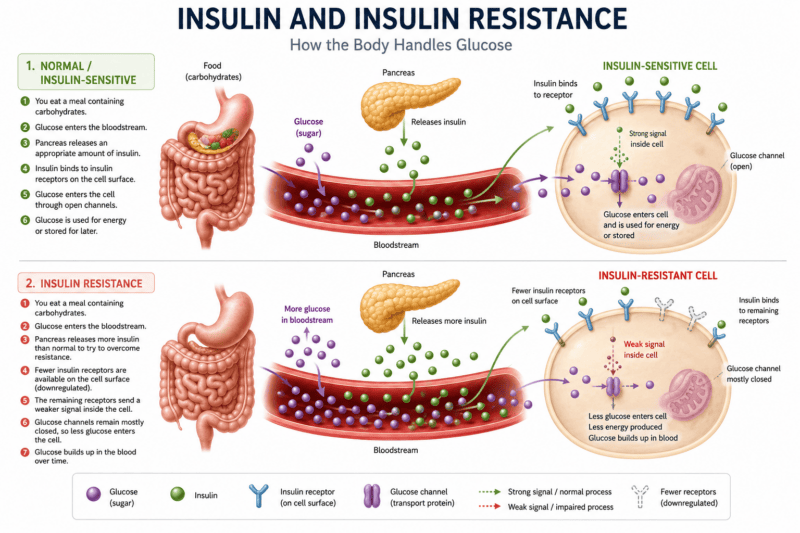
When the system is working efficiently, the pancreas releases an appropriate amount of insulin, glucose moves into cells and blood sugar returns toward baseline.
What Is Insulin Resistance?
Insulin resistance develops when cells become less responsive to insulin’s signal.
The pancreas compensates by producing more insulin.
Initially, this can work remarkably well.
Imagine that your cells used to respond when insulin “knocked on the door” once.
Now they aren’t responding as effectively, so the pancreas has to knock louder and more often.
The result can be:
Normal-looking glucose + increasingly high insulin.
Eventually, however, the pancreas may no longer be able to compensate sufficiently. Blood glucose begins to rise, and laboratory results may progress toward prediabetes and eventually type 2 diabetes.
This process generally develops over time rather than appearing overnight.
Why Does Insulin Resistance Develop?
There isn’t one single cause.
Insulin sensitivity is influenced by a combination of genetics, body composition, activity, nutrition, sleep, hormones, medications and other health factors.
Common factors associated with insulin resistance include:
- Excess visceral or abdominal fat
- Physical inactivity
- Low muscle mass
- Diets high in refined carbohydrates and highly processed foods
- Frequent consumption of sugar-sweetened beverages
- Poor sleep
- Certain medications
- Polycystic ovary syndrome (PCOS)
- Metabolic dysfunction-associated steatotic liver disease
- Family history and genetic susceptibility
- Previous gestational diabetes
Importantly, you don’t necessarily need to have obesity to have insulin resistance.
Body composition, genetics, muscle mass, fat distribution and metabolic health can vary substantially between people.
What Are the Symptoms of Insulin Resistance?
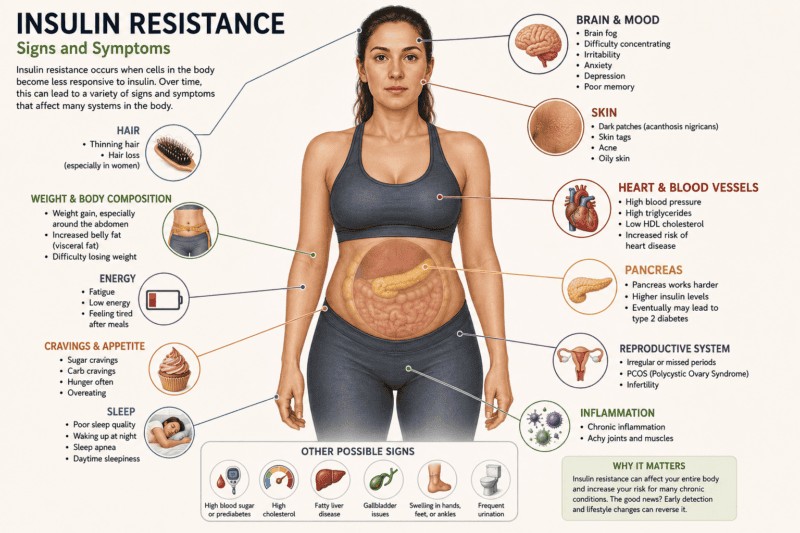
One of the challenges is that insulin resistance may cause no obvious symptoms at all.
This is why laboratory testing and assessment of risk factors can be valuable.
However, people with insulin resistance may sometimes experience or present with:
- Increased abdominal weight or difficulty losing abdominal fat
- Fatigue or sluggishness
- Hunger returning relatively quickly after meals
- Strong carbohydrate or sugar cravings
- Energy fluctuations
- Difficulty maintaining a healthy weight
- Elevated triglycerides
- Low HDL cholesterol
- Elevated blood pressure
- PCOS or irregular menstrual cycles
- Darkened, velvety skin in areas such as the neck or underarms, known as acanthosis nigricans
These symptoms aren’t specific enough to diagnose insulin resistance by themselves.
They can, however, provide reasons to look more closely at metabolic health.
Why Fasting Glucose Doesn’t Always Tell the Whole Story
Imagine two people both have a fasting glucose of 5.0 mmol/L.
On paper, their glucose looks identical.
But imagine one person’s pancreas needs only a relatively small amount of insulin to maintain that glucose level, while the other person’s pancreas is producing substantially more insulin to achieve the same result.
Those aren’t necessarily the same metabolic situations.
This is where measuring fasting insulin can add another piece of information.
Fasting Insulin: A Test We May Consider in Naturopathic Practice
Fasting insulin isn’t routinely included in standard diabetes screening panels.
However, naturopathic doctors may consider ordering it alongside fasting glucose when clinically appropriate.
This allows us to ask a different question.
Instead of only asking:
“Is the blood sugar elevated?”
we can also consider:
“How much insulin is the body producing to maintain that blood sugar?”
This can be particularly interesting when someone has metabolic symptoms or risk factors despite glucose and A1C results that haven’t yet reached the prediabetes range.
Fasting insulin isn’t a stand-alone diagnostic test for diabetes or prediabetes, and results need to be interpreted in context.
However, it can provide additional information about insulin dynamics.
What Is HOMA-IR?
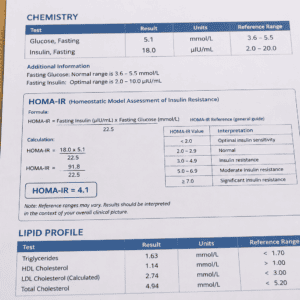
When fasting glucose and fasting insulin are measured at the same time, they can be used to calculate the Homeostatic Model Assessment of Insulin Resistance, commonly shortened to HOMA-IR.
When glucose is reported in mmol/L, the commonly used calculation is:
HOMA-IR = fasting insulin (µIU/mL) × fasting glucose (mmol/L) ÷ 22.5
The resulting number is used as an estimate of insulin resistance.
Generally, a higher HOMA-IR suggests greater insulin resistance.
However, there is an important caveat.
There isn’t one universally accepted HOMA-IR cutoff that diagnoses insulin resistance in every person.
Values can differ depending on the population, laboratory method, age and clinical circumstances.
Therefore, we don’t interpret HOMA-IR in isolation.
Instead, it can be considered alongside fasting glucose, HbA1c, fasting insulin, triglycerides, HDL cholesterol, blood pressure, waist circumference, body composition, medical history and symptoms.
What Other Bloodwork Might Be Helpful?
When assessing metabolic health, a naturopathic doctor may consider a broader laboratory picture.
Depending on the individual, this might include:
- Fasting glucose
- Fasting insulin
- HbA1c
- Lipid panel
- Triglycerides
- HDL cholesterol
- Liver enzymes
- Thyroid testing
- Vitamin B12
- Vitamin D
- Other testing based on symptoms and medical history
Sometimes the pattern across several markers is more informative than focusing on a single laboratory number.
Can Insulin Resistance Improve?
Yes.
Insulin sensitivity is highly influenced by lifestyle.
Nutrition, physical activity and body composition can meaningfully affect how efficiently the body responds to insulin.
For many patients, this is encouraging because it gives us several areas where we can intervene.
Nutrition for Insulin Resistance

There isn’t one perfect “insulin resistance diet.”
The best eating pattern needs to be sustainable and appropriate for the individual.
However, one of our main goals is usually to reduce large and repeated glucose excursions while improving overall food quality.
Start With a Lower-Glycemic Eating Pattern
The glycemic index describes how quickly carbohydrate-containing foods tend to raise blood glucose.
Rather than eliminating carbohydrates altogether, we can focus on improving carbohydrate quality and pairing.
For example, meals may emphasize:
- Non-starchy vegetables
- Adequate protein
- Healthy fats
- Nuts and seeds
- Legumes
- Berries and whole fruits
- Higher-fibre carbohydrates
- Minimally processed foods
Meanwhile, we may reduce:
- Sugary drinks
- Candy and sweets
- Refined baked goods
- Highly processed snack foods
- Large portions of refined starches
- Frequent high-sugar foods
Protein, fibre and healthy fats can also help make meals more satisfying.
What About a Modified Ketogenic or Lower-Carbohydrate Diet?
Some patients do very well with a lower-carbohydrate or modified ketogenic approach.
I generally prefer the word modified because the goal doesn’t necessarily need to be maintaining strict nutritional ketosis.
Instead, we may substantially reduce refined and high-glycemic carbohydrates while continuing to include plenty of vegetables, adequate protein, fibre and nutrient-dense foods.
For one patient, that might mean a Mediterranean-style lower-carbohydrate diet.
For another, it may involve a more significant carbohydrate reduction.
The goal is to find an eating pattern that improves metabolic health and is realistic enough to maintain.
Why Building Muscle Matters for Insulin Resistance

This is one of my favourite conversations to have with patients.
Muscle is metabolically active tissue and an important site for glucose disposal.
When we use our muscles, they require energy.
Resistance exercise can improve glucose metabolism and insulin sensitivity, while increasing or preserving lean body mass provides the body with more metabolically active tissue.
This is why improving metabolic health isn’t exclusively about making the number on the scale smaller.
Sometimes we need to shift the goal toward:
less visceral fat + more muscle.
Weight Lifting and Resistance Training
For someone who is medically able to exercise, resistance training might include:
- Weight lifting
- Resistance machines
- Resistance bands
- Body-weight exercises
- Squats
- Lunges
- Push and pull movements
You don’t need to become a bodybuilder.
The goal is progressively challenging the muscles enough that they become stronger.
Ideally, resistance exercise is combined with regular cardiovascular activity and less sedentary time.
Even walking after meals can be a useful habit.
Why the Scale Doesn’t Tell Us Everything

Two people can weigh exactly the same amount but have very different body compositions.
One may have more skeletal muscle and less visceral fat.
The other may have less muscle and more metabolically active abdominal fat.
This is why we sometimes monitor more than weight.
Depending on the patient, tracking might include:
- Waist circumference
- Body-fat percentage
- Lean body mass
- Strength
- Fitness
- Laboratory markers
- How clothing fits
- Energy and appetite
The objective is better metabolic health, not simply achieving the lowest possible body weight.
Supplements for Insulin Resistance
Supplements aren’t substitutes for nutrition, movement, sleep or appropriate medical care.
However, certain nutrients and botanical medicines may be considered as part of an individualized naturopathic treatment plan.
Berberine
Berberine is a naturally occurring plant compound that has received considerable attention for its effects on glucose metabolism.
Research suggests berberine supplementation can improve markers including fasting glucose, fasting insulin and HOMA-IR in some populations.
However, “natural” doesn’t automatically mean appropriate for everyone.
Berberine can interact with medications and isn’t suitable in every circumstance, including certain pregnancy and breastfeeding situations.
For this reason, it should be selected and dosed appropriately rather than treated as a universal blood-sugar supplement.
Inositol
Myo-inositol, sometimes used alone or in combination with D-chiro-inositol, is another nutritional supplement that may be considered.
It is particularly well known in the context of PCOS and insulin resistance, although research on inositol and glucose metabolism extends beyond PCOS.
Studies suggest inositol supplementation may improve insulin sensitivity and some measures of glucose metabolism.
Again, the appropriate formulation and dose depend on the individual.
A naturopathic doctor can help determine whether inositol, berberine or another intervention actually makes sense rather than simply adding several “blood sugar supplements” at once.
Don’t Forget About Sleep and Stress
Nutrition and exercise get most of the attention, but metabolic health doesn’t exist in isolation.
Insufficient sleep can negatively affect glucose regulation and appetite.
Chronic stress can also influence eating behaviours, activity, sleep and metabolic health.
For some patients, improving sleep quality or addressing an unsustainable stress load is an important part of the treatment plan.
How Can a Naturopathic Doctor Help?
One of the advantages of naturopathic care is having time to look at the whole metabolic picture.

Depending on the individual, we may:
- Review previous bloodwork
- Order fasting glucose and fasting insulin when appropriate
- Calculate and track HOMA-IR
- Review HbA1c and lipid markers
- Assess nutrition and carbohydrate intake
- Discuss low-glycemic or lower-carbohydrate eating patterns
- Review protein and fibre intake
- Develop realistic exercise goals
- Encourage resistance training and lean body mass development
- Discuss sleep and stress
- Recommend appropriate supplements when indicated
- Monitor progress with repeat laboratory testing
We can also work collaboratively with your family doctor, nurse practitioner, endocrinologist, registered dietitian and other members of your healthcare team when additional medical assessment or treatment is needed.
The Bottom Line
Insulin resistance can begin before fasting glucose or HbA1c becomes clearly abnormal.
In the earlier stages, the pancreas may compensate by producing more insulin to maintain blood glucose.
That’s why, in selected patients, looking at fasting glucose and fasting insulin together can provide additional information.
From there, HOMA-IR can be calculated and interpreted alongside the rest of the metabolic picture.
The good news is that insulin sensitivity can respond to changes in nutrition, physical activity and body composition.
A lower-glycemic or individualized lower-carbohydrate eating pattern, regular movement, resistance training and building lean body mass can all play important roles.
Supplements such as berberine or inositol may provide additional support for selected patients when clinically appropriate.
Ultimately, we’re not simply trying to achieve a “normal” glucose result.
We’re trying to improve how efficiently the body manages glucose and insulin in the first place.
Looking for Support With Insulin Resistance or Metabolic Health?
At Hudson Integrative Healthcare, our naturopathic doctors can assess metabolic health using your symptoms, medical history, nutrition, body composition and laboratory testing.
When appropriate, we can order laboratory testing such as fasting glucose, fasting insulin, HbA1c and other metabolic markers, then use those results to develop an individualized nutrition, exercise and supplement plan.
Naturopathic doctor appointments are available in person at Hudson Integrative Healthcare, 7 King St. East in Stoney Creek, Ontario, as well as by telemedicine throughout Ontario.
This article is for educational purposes only and is not intended to diagnose or treat insulin resistance, prediabetes or diabetes. Laboratory testing and supplements should be individualized with an appropriate healthcare professional. People with diabetes or taking glucose-lowering medications should discuss significant dietary, exercise or supplement changes with their healthcare team.
Let’s get you tested. Book Online