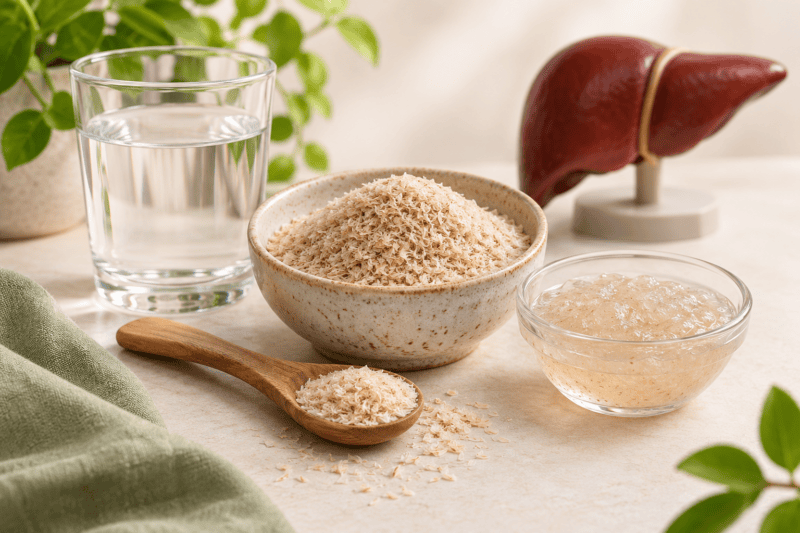
How Does Fibre Lower Cholesterol? Understanding Psyllium and Bile Acid
Written by Dr. Melanie Hudson, ND
Edited for Hudson Integrative Healthcare
You may have heard that eating more fibre can help lower cholesterol. But how does something that stays inside your digestive tract affect cholesterol circulating in your blood?
Psyllium offers a helpful example. This gel-forming fibre interferes with the recycling of bile acids in your intestine. Your liver then uses cholesterol to replace those bile acids—and increases its removal of LDL particles from your bloodstream.
It is a fascinating connection between digestive health and cholesterol management, and it helps explain why the type of fibre matters.
What Is Psyllium?
Psyllium is a plant-derived fibre commonly found in products used to support bowel regularity. When mixed with water, it forms a thick, viscous gel. That gel is central to its cholesterol-lowering effects.
Although psyllium is often associated with constipation, research also supports its use for modest reductions in LDL cholesterol.
Start With Bile: Your Body’s Recycling System
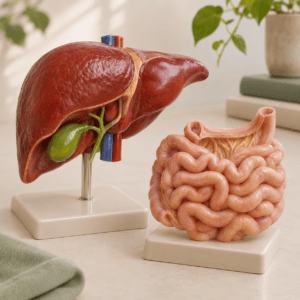 Your liver makes bile acids from cholesterol. These bile acids enter the small intestine, where they help your body digest and absorb dietary fats.
Rather than making an entirely new supply after every meal, your body normally reabsorbs and recycles most of them. They return to the liver and can be used again.
Psyllium interferes with this recycling process.
How Psyllium Helps Lower LDL Cholesterol
1. It forms a gel in the digestive tract
As psyllium takes up water, it creates a viscous gel within the intestinal contents. This makes it harder for some bile acids to be reabsorbed.
2. More bile acids leave in stool
Bile acids that escape reabsorption pass out of the body in bowel movements. The liver must replace these losses to maintain the supply needed for digestion.
3. The liver uses cholesterol to make replacements
Producing new bile acids uses cholesterol within the liver. Human research supports increased bile acid synthesis as an important mechanism behind psyllium’s LDL-lowering effect.
4. The liver removes more LDL from the blood
As the liver’s available cholesterol decreases, it increases LDL receptor activity. These receptors help remove LDL particles from circulation, lowering blood LDL cholesterol.
The useful takeaway: psyllium changes what happens in the intestine, and the liver responds by changing how it handles cholesterol.
Does Psyllium “Absorb Cholesterol”?
Describing fibre as a sponge that soaks cholesterol out of the blood misses the connection between the intestine and liver.
Psyllium acts within the digestive tract. Its interference with bile acid recycling helps trigger greater cholesterol use and LDL clearance by the liver.
However, saying that it has no effect on intestinal cholesterol absorption would also be too absolute. One small human trial found reduced fractional cholesterol absorption—the proportion absorbed—although the absolute amount absorbed did not change. The researchers concluded that stimulation of bile acid synthesis was the primary explanation for the LDL reduction.
Is the Effect Mechanical or Metabolic?
You may see claims that psyllium lowers cholesterol through a “purely mechanical” process.
That wording leaves out an important part of the story.
The gel’s action in the intestine is physical. But making replacement bile acids and increasing LDL receptor activity are metabolic responses. Both are involved in the overall effect.
How Much Can Psyllium Lower Cholesterol?
A 2018 systematic review and meta-analysis combined 28 randomized controlled trials involving 1,924 participants.
At a median dose of approximately 10.2 grams of psyllium daily, researchers found average reductions of:
- LDL cholesterol: 0.33 mmol/L, equivalent to approximately 13 mg/dL.
- Non-HDL cholesterol: 0.39 mmol/L.
- Apolipoprotein B, or ApoB: 0.05 g/L.
These are average results across studies. Individual responses vary, and the same dose will not produce the same changes.
For example, an LDL reduction of 0.33 mmol/L would bring a starting result of 4.0 mmol/L to approximately 3.67 mmol/L. That illustrates the size of the average effect; it does not predict an individual patient’s response.
Psyllium can be a useful addition to a cholesterol management plan. Whether that reduction is sufficient depends on your starting results, treatment goals, and overall cardiovascular risk.
Does Every Type of Fibre Work This Way?
No. Soluble fibre is a broad category, and not all soluble fibres form the same gel.
Viscous, gel-forming fibres—including psyllium and beta-glucan from oats and barley—have evidence for cholesterol lowering. Nonviscous fibres such as inulin and wheat dextrin do not consistently produce the same LDL-lowering effect. Insoluble wheat bran also does not reproduce this particular benefit.
This does not make other fibres unhelpful. It means that a product labelled “fibre supplement” should not automatically be expected to lower cholesterol. The fibre’s properties and dose matter.
Using Psyllium Safely
If psyllium is appropriate for you, a few practical details matter.
Check the actual psyllium content. The approximately 10 grams daily studied refers to psyllium, rather than necessarily 10 grams of a flavoured product containing other ingredients. Read the medicinal ingredient amount and follow the product instructions.
Build up gradually. Gas and bloating can occur, particularly when starting. Begin with a smaller labelled dose and discuss how to increase it with your healthcare provider.
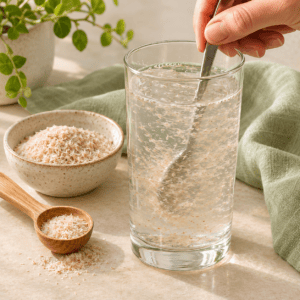
Always use enough liquid. Health Canada advises at least 250 mL of liquid with each dose, mixing well and drinking immediately. Follow your product’s directions if they require more. Never swallow psyllium powder dry.
Review medication timing. Psyllium can interfere with the absorption of some oral medications. Health Canada recommends taking it a few hours before or after other medications or health products; your pharmacist can advise on the interval needed for your specific prescriptions.
Consider swallowing and digestive conditions. Psyllium should not be used by people with difficulty swallowing. Known or suspected intestinal blockage, or unexplained abdominal symptoms, require medical assessment before use. Seek urgent help for difficulty swallowing or breathing after taking it.
Where Does Psyllium Fit Into Your Cholesterol Plan?
A fibre supplement is one possible part of an individualized plan. It should be considered alongside your nutrition, existing treatment, medical history, and follow-up bloodwork.
An improvement in LDL is encouraging, but it does not automatically mean that every cardiovascular risk factor has been addressed or that prescribed medication is no longer needed.
At Hudson Integrative Healthcare, our naturopathic doctors can help you review your cholesterol results, consider appropriate nutrition strategies, and decide whether a fibre supplement fits your care plan. In-person appointments are available in Stoney Creek, with virtual naturopathic care available across Ontario.
Hudson Integrative Healthcare
7 King Street East, Unit 1
Stoney Creek, Ontario
Phone: 905-662-0045
Website: www.hihealthcare.ca
Book an appointment online
This article is for educational purposes and does not replace individualized medical advice, diagnosis, or treatment. Speak with your healthcare provider before starting a supplement or changing prescribed treatment.
You May Also Enjoy Our Other Related Blogs
- Beyond Good and Bad Cholesterol: Understanding Advanced Cholesterol Testing and Cardiovascular Health
- Virtual Naturopathic Appointments Across Ontario
References
- McRorie JW Jr, McKeown NM. Understanding the physics of functional fibers in the gastrointestinal tract: An evidence-based approach to resolving enduring misconceptions about insoluble and soluble fiber. Journal of the Academy of Nutrition and Dietetics. 2017;117(2):251–264. https://doi.org/10.1016/j.jand.2016.09.021
- Everson GT, Daggy BP, McKinley C, Story JA. Effects of psyllium hydrophilic mucilloid on LDL-cholesterol and bile acid synthesis in hypercholesterolemic men. Journal of Lipid Research. 1992;33(8):1183–1192. https://pubmed.ncbi.nlm.nih.gov/1431597/
- Jovanovski E, et al. Effect of psyllium (Plantago ovata) fiber on LDL cholesterol and alternative lipid targets, non-HDL cholesterol and apolipoprotein B: A systematic review and meta-analysis of randomized controlled trials. American Journal of Clinical Nutrition. 2018;108(5):922–932. https://pubmed.ncbi.nlm.nih.gov/30239559/
- Health Canada. Psyllium: Natural Health Product Monograph. July 26, 2024. View monograph.
- National Library of Medicine. Psyllium. MedlinePlus Drug Information. Revised June 20, 2024. https://medlineplus.gov/druginfo/meds/a601104.html