
Vaginal Estriol Cream: A Simple Treatment for Vaginal Dryness, Irritation and Proactive Care
Written by Dr. Melanie Hudson, ND
Edited for Hudson Integrative Healthcare
Vaginal dryness, irritation and discomfort are incredibly common — but many women assume they are simply something they have to tolerate as they get older.
Maybe intercourse has become uncomfortable when it never used to be.
The vaginal opening may feel irritated, tender or dry. Tissue may feel more fragile. Some women notice burning, urinary urgency or recurrent urinary tract infections.
And because these changes can happen gradually, many women do not immediately connect them with declining estrogen.
One treatment we commonly discuss for these symptoms is low-dose vaginal estrogen, including compounded estriol vaginal cream.
Unlike systemic hormone replacement therapy, vaginal estrogen is used primarily to treat the tissues of the vagina, vulva and lower urinary tract directly.
For the right patient, it can make an enormous difference in comfort and quality of life.
What Happens to Vaginal Tissue When Estrogen Declines?
Estrogen receptors are found throughout the vagina, vulva, urethra and bladder.
These tissues respond to changes in estrogen throughout a woman’s reproductive life — which is why vaginal symptoms do not necessarily begin only after menopause.
During the reproductive years, estrogen and progesterone generally follow relatively predictable patterns across the menstrual cycle. As a woman enters perimenopause, ovulation becomes less consistent, progesterone production tends to decline, and estrogen can become much more variable — sometimes relatively high and sometimes quite low.
Eventually, as menopause approaches and ovarian activity declines, estrogen levels become persistently lower.
This transition can affect vaginal and vulvar tissues before menstrual periods have stopped completely.
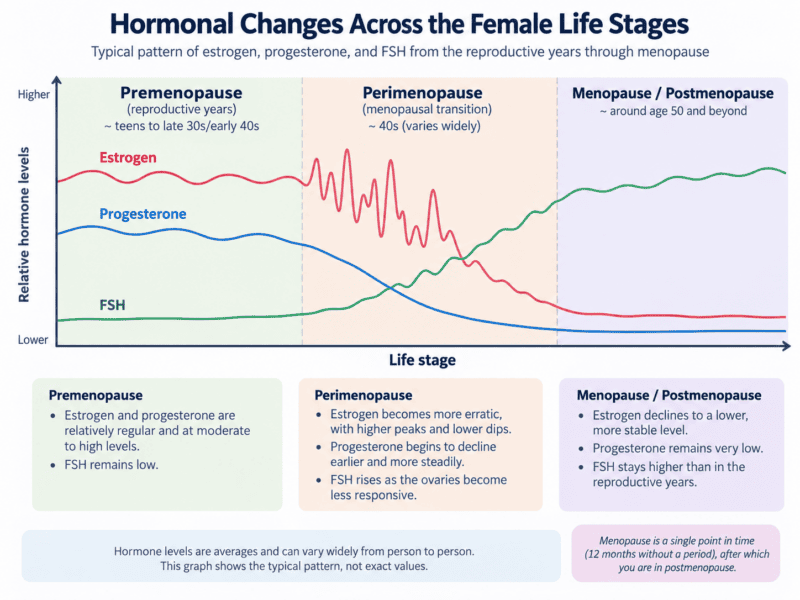
Hormone patterns during the menopausal transition are highly individual. This illustration shows general trends rather than the hormone levels of any particular woman.
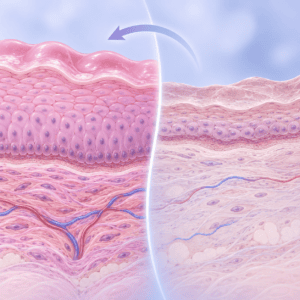
As estrogen becomes less consistent and eventually declines, vaginal tissues can gradually become:
- Thinner and more fragile
- Drier
- Less elastic
- Less naturally lubricated
- More easily irritated
- More sensitive to friction or penetration
Blood flow to the tissues can also decrease, and changes in vaginal pH and the vaginal microbiome can occur.
This collection of vaginal, vulvar and urinary changes is known as genitourinary syndrome of menopause, or GSM.
You may also have heard older terms such as vaginal atrophy or vulvovaginal atrophy.
And despite the word menopause in the name, symptoms of GSM can begin during the perimenopausal transition, sometimes years before a woman’s final menstrual period.
Symptoms can include:
- Vaginal dryness
- Burning or irritation
- Itching
- Vaginal or vulvar tenderness
- Pain with intercourse
- Reduced natural lubrication
- Tightness or discomfort with penetration
- Fragile vaginal tissue
- Spotting or light bleeding associated with friction
- Urinary urgency or frequency
- Burning with urination
- Recurrent urinary tract infections
- Changes in sexual comfort and function
These symptoms are common, but that does not mean women simply have to accept them.
They are often very treatable.
What Is Vaginal Estriol Cream?
Estriol is one form of estrogen.
When prescribed as a vaginal cream, a small amount is applied directly to vaginal and vulvar tissues where estrogen support is needed.
At Hudson Integrative Healthcare, our naturopathic doctors who have met Ontario’s prescribing requirements can prescribe certain bioidentical hormones within their regulated scope of practice. One formulation we commonly use is compounded estriol 0.1% vaginal cream, prepared by a compounding pharmacy according to an individualized prescription. Ontario’s naturopathic prescribing regulations permit bioidentical estrogen when compounded in topical or suppository form.
Compounded Estriol 0.1% Is Not the Same as Estragyn 0.1%
The similar names and concentrations can understandably be confusing.
Compounded estriol 0.1% vaginal cream is different from Estragyn Vaginal Cream 0.1%, a commercially manufactured vaginal estrogen product available in Canada. Estragyn contains estrone rather than estriol.
Both are forms of local vaginal estrogen therapy, but they are different estrogen preparations and should not be used interchangeably when discussing a specific prescription.
Throughout this article, when I refer specifically to estriol 0.1%, I mean compounded estriol 0.1% vaginal cream. When discussing research and treatment recommendations that apply to vaginal estrogen products more broadly, I will use the term low-dose vaginal estrogen.
How Is Vaginal Estrogen Different From Systemic HRT?
This distinction is important.
Systemic estrogen — whether taken orally or delivered through a patch, gel or other systemic preparation — is intended to raise estrogen exposure throughout the body.
That can be useful for symptoms such as:
- Hot flashes
- Night sweats
- Sleep disruption
- Certain systemic menopausal symptoms
Vaginal estrogen has a different purpose.
It is placed directly at the tissues experiencing estrogen deficiency and is generally used in much lower doses.
Canadian guidelines state that the doses used in vaginal estrogen therapy result in little to minimal increases in serum estradiol, and recommend local vaginal estrogen as an effective treatment for GSM. (SOGC)
That is why the risk considerations for low-dose vaginal estrogen should not simply be assumed to be identical to those for systemic HRT.
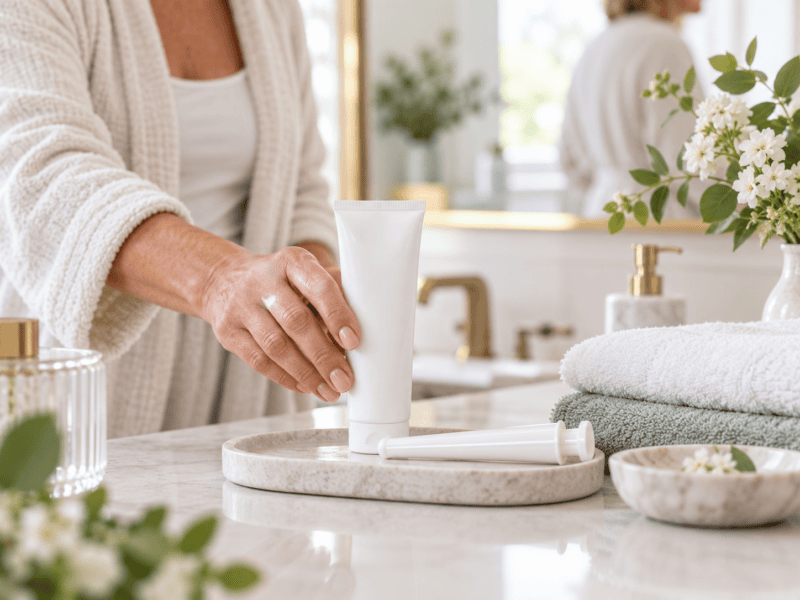
What Does Vaginal Estrogen Actually Do?
Vaginal estrogen does more than temporarily make dry tissue feel lubricated.
Estrogen helps maintain the structure and function of estrogen-sensitive genital and urinary tissues.
With treatment, vaginal estrogen can help improve:
- Vaginal moisture
- Tissue thickness and integrity
- Elasticity
- Blood flow
- Natural lubrication
- Vaginal pH
- Comfort with intercourse
- Burning and irritation
- Overall vulvovaginal tissue health
That is an important difference between vaginal estrogen and a lubricant.
A lubricant can reduce friction during intercourse.
A vaginal moisturizer may temporarily improve dryness.
Vaginal estrogen is intended to address the underlying estrogen deficiency affecting the tissue itself.
For many women, this means the tissue gradually becomes more comfortable, resilient and functional rather than simply being lubricated temporarily.
One of Our Common Prescriptions: Compounded Estriol 0.1% Cream

One formulation I commonly prescribe is:
Compounded estriol 0.1% vaginal cream
A maintenance prescription may look something like:
Apply 1 gram vaginally once weekly on an ongoing basis.
That is an example of a regimen I may use in practice — not a universal dosing instruction for every woman.
Some patients require a more frequent introductory phase before transitioning to weekly maintenance. Others may need a different amount or frequency depending on their symptoms, tissue changes, medical history and response to treatment.
The prescription should therefore always be individualized.
But once symptoms and tissue health are well controlled, the simplicity of a maintenance schedule is one of the things many patients appreciate:
One application. Once a week. Ongoing.
And it is one of those treatments where we frequently hear some version of:
“Why did nobody tell me about this sooner?”
You Don’t Have to Wait Until Menopause to Address Vaginal Symptoms
One misconception I hear is that vaginal estrogen is something women should consider only after menopause — or only once vaginal atrophy has become severe.
That isn’t necessarily the case.
As the hormone illustration above shows, estrogen does not simply remain steady until the day menopause occurs and then suddenly disappear.
During perimenopause, estrogen production becomes increasingly variable. A woman may still be menstruating — sometimes quite regularly — while also experiencing periods of lower estrogen exposure that begin affecting vaginal and vulvar tissues.
For some women, the first sign is subtle:
- They suddenly need lubricant when they never did before.
- Intercourse feels a little less comfortable.
- The vaginal opening feels dry or irritated.
- They notice burning after sex.
- Tissue feels more sensitive or easily irritated.
- Urinary symptoms begin appearing more often.
These symptoms can occur years before the final menstrual period.
So a woman does not necessarily need to wait until she is officially menopausal, or until significant vaginal atrophy has developed, before asking whether estrogen deficiency could be contributing to her symptoms.
If symptoms are present and vaginal estrogen is medically appropriate, local treatment can be considered during the perimenopausal transition as well as after menopause.
The goal is not to prescribe vaginal estrogen preventively to every woman simply because she has entered her 40s or perimenopause. Rather, it is to recognize estrogen-related tissue changes when they begin, assess other possible causes, and treat bothersome symptoms appropriately instead of telling women to wait until they become severe.
Because GSM tends to persist rather than spontaneously resolve once estrogen remains low, addressing symptoms earlier may also help maintain comfortable, healthy vaginal tissue over time.
Is There an Age Limit for Vaginal Estrogen?
This is one of the most important points I want women to understand.
There is not an arbitrary birthday when vaginal estrogen suddenly becomes inappropriate simply because of age.
You may have heard discussions about the risks and benefits of starting systemic menopausal hormone therapy after age 60 or many years after menopause.
Those considerations should not automatically be applied to low-dose local vaginal estrogen.
Vaginal estrogen can potentially be started later in life when clinically appropriate, including in women who have been postmenopausal for many years.
And if it is working well and remains appropriate for the individual, there is not necessarily a predetermined age when it must be discontinued.
Current menopause guidance continues to distinguish local low-dose vaginal estrogen from systemic hormone therapy because systemic exposure is minimal. (The Menopause Society)
So rather than thinking:
“I’m too old to start hormones.”
A better question may be:
“Could estrogen deficiency be contributing to these symptoms, and would local vaginal treatment be appropriate for me?”
What About Women Who Are Younger?
Low estrogen is not exclusive to women who have completed menopause.
Estrogen levels can fluctuate or fall at other stages of life as well, and younger women can experience many of the same symptoms of vaginal dryness, irritation, tissue sensitivity and painful intercourse.
Vaginal Dryness Can Also Occur Postpartum

The postpartum period is a good example.
After delivery, estrogen and progesterone levels fall dramatically. Estrogen can remain relatively low for some time afterward, particularly in women who are breastfeeding and whose menstrual cycles and regular ovulation have not yet returned.
As a result, some women experience symptoms that feel very similar to the vaginal changes associated with menopause, including:
- Vaginal or vulvar dryness
- Burning or irritation
- Increased tissue sensitivity
- Reduced natural lubrication
- Discomfort with penetration
- Pain with intercourse
ACOG specifically notes that vaginal dryness is common after childbirth, particularly while breastfeeding, because of changes in hormone levels, and that local estrogen therapy can be used to help treat postpartum vaginal dryness.
For appropriately selected patients, local vaginal estrogen — including compounded estriol when prescribed within the clinician’s scope — may therefore be considered during the postpartum period as well. A woman does not necessarily need to wait for her menstrual cycle to return if low-estrogen vaginal symptoms are already significantly affecting comfort or sexual function.
If a woman is breastfeeding, however, the prescription should be individualized. Estrogen exposure can potentially affect milk production, particularly when started before lactation is well established, and the amount transferred into breast milk depends on the estrogen preparation and route of administration. Evidence specifically for compounded vaginal estriol during lactation is more limited, so this is something to discuss with the prescribing clinician rather than applying a standard regimen to every postpartum patient.
It is also important not to assume that every episode of postpartum pain or painful intercourse is hormonal. Healing from vaginal delivery, scar tissue, pelvic floor muscle tension, infections and other postpartum changes can produce similar symptoms and may require different treatment.
Some women also begin experiencing vulvovaginal symptoms during the perimenopausal transition, long before they have gone 12 months without a menstrual period.
The important question is therefore not simply:
“How old are you?”
It is:
“Why are these symptoms occurring?”
Dryness, burning, irritation and painful intercourse can have several possible causes, so appropriate assessment helps determine whether local estrogen, pelvic floor treatment, another therapy — or a combination — is most appropriate.
Vaginal Symptoms Are Not Always Estrogen Deficiency
This is important.
Not every uncomfortable vagina needs estrogen.
Symptoms that resemble GSM can also occur with:
- Yeast infections
- Bacterial vaginosis
- Sexually transmitted infections
- Contact or irritant dermatitis
- Vulvar dermatologic conditions
- Lichen sclerosus
- Pelvic floor dysfunction
- Vulvodynia
- Urinary tract infections
- Other gynecologic conditions
Pain with intercourse can also have several overlapping causes.
And new vaginal bleeding — particularly bleeding after menopause — needs appropriate medical assessment rather than simply being attributed to dryness or vaginal atrophy.
The goal is to understand why the symptoms are occurring and then choose the appropriate treatment.
What About Breast Cancer?
This is an area where individualized decision-making is particularly important.
A history of estrogen-sensitive breast cancer does not necessarily mean that every patient can never use vaginal estrogen, but it is also not something I would prescribe casually without considering the person’s cancer history and current treatment.
Nonhormonal options are generally tried first.
If symptoms remain significant, low-dose vaginal estrogen may sometimes be considered after a discussion of potential risks and benefits.
ACOG states that low-dose vaginal estrogen may be considered in individuals with a history of breast cancer, including those taking tamoxifen, after nonhormonal treatments have been inadequate. For patients taking an aromatase inhibitor, ACOG recommends shared decision-making involving the patient, gynecologist and oncologist. (ACOG)
This is a good example of why the statement “vaginal estrogen is safe” needs a little context.
For most patients it has a very favourable safety profile, but individual medical history still matters.
Do You Need Progesterone With Vaginal Estrogen?
Women who still have a uterus are often told that if they take systemic estrogen, they may also require progesterone to protect the uterine lining.
So naturally, many patients ask whether the same rule applies to vaginal estrogen.
With recommended low-dose local vaginal estrogen therapy, concurrent progesterone is generally not required solely because vaginal estrogen is being used.
Canadian GSM guidance specifically states that clinically significant systemic hormone absorption does not occur with low-dose vaginal estrogen and therefore concomitant progestogen therapy is not needed. (SOGC)
Again, the exact product, dose and the patient’s overall hormone prescription matter.
Someone who is also using systemic estrogen may have completely different progesterone requirements.
What About Recurrent UTIs?
The vagina is not the only place affected by falling estrogen.
Estrogen-responsive tissues also extend into the lower urinary tract.
As estrogen declines, changes can occur in:
- Vaginal pH
- Vaginal flora
- Urethral tissue
- Bladder and urinary tract function
These changes can contribute to urinary symptoms and recurrent urinary tract infections in some postmenopausal women.
Vaginal estrogen is therefore not only used for vaginal dryness and painful intercourse.
It can also be an important part of the management of recurrent UTIs in appropriately selected postmenopausal patients.
What If Sex Has Become Painful?
Pain with intercourse — medically called dyspareunia — is one of the most common reasons women eventually bring these symptoms up.
Sometimes women compensate for years. Eventually, they may avoid penetration altogether because it simply isn’t comfortable.
If estrogen deficiency is contributing to the problem, improving the vaginal tissue itself can make a significant difference.
But I also want to emphasize that painful intercourse is not always purely hormonal.
Pelvic floor muscle tension, vulvodynia, endometriosis, dermatologic conditions, infections and other causes can contribute.
Sometimes the best treatment plan includes both vaginal estrogen and pelvic floor physiotherapy or another form of care.
Do You Have to Keep Using It?
Often, yes — if you want the benefit to continue.
This is another important difference between genitourinary syndrome of menopause and symptoms such as hot flashes.
Hot flashes may eventually improve as a woman moves further beyond menopause.
Vaginal estrogen deficiency does not necessarily resolve in the same way because ovarian estrogen levels remain low.
If treatment is discontinued, dryness, irritation and tissue changes may gradually return. Guidelines also note that the protective effect of vaginal estrogen against recurrent urinary tract infections appears to diminish after treatment is stopped.
That is why I often describe vaginal estrogen to patients as maintenance for estrogen-sensitive vaginal and urinary tissues, rather than a short course that permanently fixes the problem.
Think of it less like taking an antibiotic for seven days and being finished, and more like continuing to support tissues that are no longer receiving the same amount of estrogen naturally.
There May Be Preventive Benefits as Women Get Older

Continuing vaginal estrogen can be about more than maintaining comfort.
After menopause, falling estrogen affects the vagina, urethra and lower urinary tract. Changes in vaginal pH, tissue integrity and the vaginal microbiome can contribute to a greater susceptibility to recurrent urinary tract infections.
For women who experience recurrent UTIs, vaginal estrogen is now specifically recommended in major clinical guidelines as a way to reduce the risk of future infections.
This can become increasingly important in the later decades of life.
Although most bladder infections are readily treated, UTIs in older adults can occasionally progress to kidney infection, bloodstream infection or urosepsis, which can become life-threatening. Adults over 65 are among the groups at higher risk of developing sepsis from infection.
So for an older woman who has recurrent urinary infections or ongoing genitourinary symptoms, maintaining healthy estrogen-responsive tissue may have a preventive role as well as a symptom-relief role.
This does not mean that every woman should use vaginal estrogen indefinitely solely to prevent a future bladder infection. The benefit is most relevant for women with GSM symptoms, recurrent UTIs, or other appropriate clinical indications.
But there is also no reason to assume that vaginal estrogen should automatically be discontinued simply because a woman reaches 70, 80 or beyond.
If low-dose vaginal estrogen is working well, tolerated and remains medically appropriate, continuing treatment into older age may help maintain vaginal and urinary tissue health and reduce recurrent UTI risk.
Periodic reassessment is still appropriate.
Local Estrogen Is Still Hormone Therapy — But Context Matters
The word estrogen understandably makes some women nervous.
For decades, women have heard complicated and sometimes frightening messages about hormone therapy.
But all forms of estrogen therapy are not interchangeable.
There is an important difference between:
Systemic estrogen intended to circulate throughout the body
and
Low-dose vaginal estrogen intended primarily to treat local genital and urinary tissues.
That distinction is central to understanding both its benefits and its safety profile.
It is still a prescription hormone treatment.
It should still be chosen thoughtfully.
But women should not automatically assume that the risk conversations surrounding systemic HRT apply identically to a very low-dose local vaginal treatment.
A Small Treatment That Can Make a Big Difference
Vaginal symptoms can have a surprisingly large effect on quality of life.
Dryness can become irritation.
Irritation can become pain.
Pain can interfere with intimacy.
Urinary discomfort or recurrent infections can become disruptive.
And over time, some women simply begin accommodating their symptoms without realizing there may be an effective treatment available.
For appropriately selected patients, low-dose vaginal estrogen — including compounded estriol 0.1% vaginal cream — can be a simple and very well-liked treatment option.
It isn’t about trying to turn back the clock.
It is about helping maintain healthy, comfortable estrogen-responsive tissue and allowing women to continue feeling comfortable in their bodies — whether they are in perimenopause, recently menopausal or many years beyond menopause.
Could Vaginal Estriol Cream Be Right for You?
The prescribing naturopathic doctors at Hudson Integrative Healthcare offer individualized care for women experiencing vaginal dryness, irritation, painful intercourse, urinary symptoms and other concerns related to perimenopause, menopause and other low-estrogen states. Where appropriate, treatment may include prescription hormone therapy such as compounded estriol vaginal cream, alongside assessment of other factors that may be contributing to symptoms.
If you already have a primary naturopathic doctor who does not have advanced prescribing rights, you do not necessarily need to transfer your overall naturopathic care. Your ND can refer you to one of our prescribing naturopathic doctors for an HRT-focused consultation only, and the two practitioners can collaborate so that your hormone prescription is coordinated with your existing treatment plan.
This can be especially helpful for patients who are happy with their current naturopathic doctor but need access to a practitioner who is able to assess and prescribe hormone therapy when appropriate.
Appointments are available in person at our Stoney Creek clinic and through telemedicine across Ontario.
Hudson Integrative Healthcare
7 King St E, Unit 1
Stoney Creek, Ontario L8G 1J7
905-662-0045
This article is intended for general educational purposes and does not replace individualized medical assessment or treatment.
Book An Appointment