
Constipation in Children: Why Daily Bowel Movements Don’t Always Mean Your Child Isn’t Constipated
Written by Dr. Melanie Hudson, ND
Edited for Hudson Integrative Healthcare
When parents think about constipation, they often picture a child who hasn’t had a bowel movement for several days.
But childhood constipation isn’t always that obvious.
A child can have a bowel movement every day and still have significant stool retained in the colon or rectum. They may be passing only part of what has accumulated, passing small amounts frequently, or even experiencing loose stool or soiling around harder retained stool.
This can make constipation surprisingly difficult for parents to recognize.
Sometimes the clues aren’t primarily about bowel movements at all. Instead, parents may notice:
- Recurrent stomach aches
- Abdominal bloating or fullness
- Reduced appetite
- Irritability or emotional changes
- Avoiding the toilet
- Pain with bowel movements
- Very large bowel movements
- Small, hard pellet-like stools
- Stool accidents or underwear staining
- A child saying their stomach hurts without being able to explain exactly where
Understanding what is actually happening in the bowel can make a significant difference.
What Does Constipation Look Like in Children?
Constipation is about more than how frequently a child goes to the bathroom.
Healthcare providers also consider stool consistency, size, discomfort, withholding behaviours and whether bowel movements appear complete.
For example, a child may poop every day but pass only a relatively small amount while stool continues accumulating.
Other children develop very large bowel movements every few days. Some pass small hard pellets. Others experience loose stool or staining in their underwear.
This last situation can be particularly confusing.
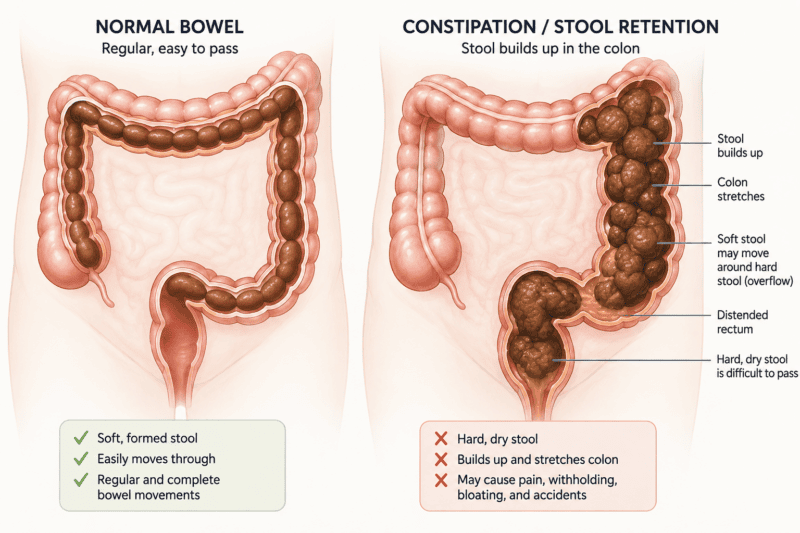
When a large amount of stool is retained in the rectum, softer stool may sometimes move around it. Parents may understandably interpret this as diarrhea when the underlying problem can actually be constipation with overflow soiling.
Why Do Children Hold Their Bowel Movements?
One of the most common patterns in childhood constipation is stool withholding.
It can start very innocently.
Perhaps a child has one painful bowel movement. The next time they feel the urge to poop, they remember that discomfort and try not to go.
Young children may:
- Stand stiffly
- Cross their legs
- Clench their buttocks
- Hide behind furniture
- Rock or fidget
- Walk on their tiptoes
- Refuse to sit on the toilet
Ironically, parents sometimes interpret these behaviours as the child trying to have a bowel movement when they may actually be trying to prevent one.
The longer stool remains in the colon, the more water can be removed from it. The stool can then become larger, harder and more difficult to pass.
Another painful bowel movement reinforces the fear.
A cycle can develop:
Pain → withholding → harder stool → more pain → more withholding.
Breaking that cycle is an important part of treatment.
Can a Child Be Constipated if They Poop Every Day?
Yes.
This is one of the most important things for parents to understand.
Having a daily bowel movement tells us that some stool is leaving the body. It doesn’t necessarily tell us that the bowel is emptying adequately.
A child might pass a small bowel movement every day while continuing to retain stool.
This is why we look at the whole picture:
- How often are they going?
- How much are they passing?
- What does the stool look like?
- Is it hard, soft, formed or loose?
- Is it painful?
- Do they seem to empty completely?
- Do they feel better afterward?
- Are they withholding?
- Are they having accidents or staining?
- Does their abdomen regularly become uncomfortable or distended?
Using the Bristol Stool Chart
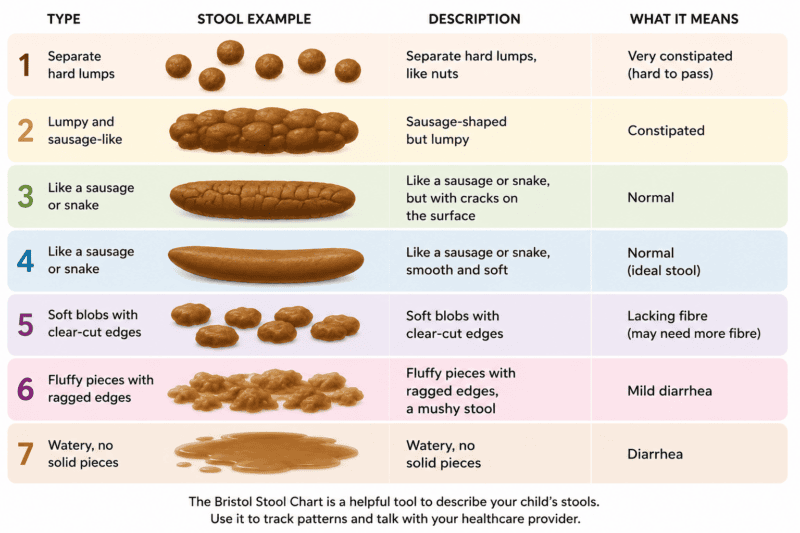
The Bristol Stool Chart can be a great visual reference for parents learning how to recognize and describe their child’s stool consistency.
Rather than simply saying a bowel movement was “normal,” “hard” or “loose,” the chart divides stool into seven recognizable types, ranging from separate hard pellets to entirely liquid stool.
For parents who are tracking constipation, this can make conversations with healthcare providers much more useful.
You might discover, for example, that a child who technically has a bowel movement every day is consistently passing small, hard stools.
Keeping a simple bowel diary that records frequency, approximate amount and Bristol stool type can help reveal patterns that aren’t obvious from bowel frequency alone.
What Is Fecal Impaction?
Fecal impaction occurs when a significant amount of stool becomes retained and accumulated in the bowel.
The rectum can gradually stretch to accommodate that stool.
Over time, the normal sensation telling a child that they need to have a bowel movement may become less effective. This can make the problem even more difficult to recognize.
A child with significant stool retention may still pass bowel movements.
They may also experience:
- Abdominal discomfort
- Bloating
- Very large stools
- Small frequent stools
- Stool withholding
- Overflow soiling
- Reduced appetite
- Pain with bowel movements
This is why simply asking “Did you poop today?” doesn’t always give parents the whole answer.
Does My Child Need an X-Ray for Constipation?
Parents sometimes wonder whether an abdominal X-ray can show how much stool is present, particularly when they aren’t sure whether constipation is responsible for their child’s discomfort.
In certain clinical situations, a pediatrician or specialist may decide that imaging is appropriate. However, abdominal X-rays are not routinely recommended for diagnosing functional constipation or fecal impaction.
Instead, constipation and suspected fecal impaction are generally assessed through a detailed history and appropriate physical examination.
If the picture remains unusual, severe or difficult to manage, your child’s physician or specialist can determine whether imaging or another investigation is appropriate.
Constipation Can Affect Appetite
This is another connection parents don’t always expect.
Imagine trying to eat a full meal while your abdomen already feels full and uncomfortable.
Children with significant stool retention may:
- Eat smaller meals
- Say they’re not hungry
- Become picky around food
- Feel full quickly
- Complain that their stomach hurts after eating
Interestingly, parents sometimes notice that their child’s appetite improves dramatically after passing a particularly large bowel movement.
Therefore, when a child develops unexplained appetite changes alongside abdominal complaints, their bowel habits are worth considering.
Constipation Can Affect a Child Emotionally Too
Constipation isn’t simply a digestive inconvenience.
For some children, it becomes stressful.
They may become anxious about using the bathroom because they associate bowel movements with pain.
Older children can become embarrassed about stool accidents or soiling.
Parents may also notice:
- Irritability
- Tearfulness
- Difficulty concentrating when uncomfortable
- Fear around toileting
- Battles about sitting on the toilet
- Anxiety about using bathrooms outside the home
- Embarrassment about accidents
Then the emotional stress itself can reinforce withholding.
This is why constipation treatment should be supportive and non-punitive.
A child experiencing stool accidents because of significant constipation isn’t necessarily being careless or refusing to use the bathroom.
There may be a physical reason they aren’t recognizing or responding normally to the urge to go.
Treating Stool Retention Comes First
Increasing fibre, eating fruits and vegetables and drinking enough water are all important for long-term bowel health.
However, when a child already has significant stool retention, diet alone may not be enough to correct it.
This distinction is important.
If a large amount of stool has accumulated, the first goal may be disimpaction, followed by a maintenance phase designed to keep bowel movements consistently soft and prevent stool from accumulating again.
Current pediatric guidelines support polyethylene glycol (PEG) as an established treatment for pediatric functional constipation and disimpaction.
Other osmotic approaches may also be considered depending on the individual child and the healthcare professional overseeing treatment.
Where Does Magnesium Fit Into Childhood Constipation?
Magnesium can have an osmotic effect in the bowel, meaning it can help draw water into the intestinal contents and soften stool.
In naturopathic practice, forms such as magnesium citrate or magnesium oxide may sometimes be considered as part of an individualized constipation plan.
The goal isn’t simply to give a child “more magnesium.”
Instead, the goal is to achieve consistently soft, comfortable and adequately complete bowel movements while addressing the factors that contributed to constipation in the first place.
For children who tend toward recurrent hard stools, keeping the stool soft enough to pass comfortably can also help interrupt the cycle of:
Pain → withholding → harder stool → more pain.
The amount required can vary substantially between children. Age, body size, severity of constipation, kidney function, medications, supplements and other medical conditions all matter.
For that reason, therapeutic magnesium for a child—particularly larger amounts being used specifically for constipation—should be discussed with an appropriately qualified healthcare provider rather than dosed at home based on general internet recommendations.
When significant fecal impaction is suspected, parents should also seek appropriate medical assessment rather than simply continuing to increase magnesium or another laxative on their own.
A Successful Bowel Movement Doesn’t Necessarily Mean Treatment Is Finished
This is one of the biggest challenges with chronic childhood constipation.
Parents understandably feel relieved when their child finally has several large bowel movements.
However, if the bowel has been chronically stretched by retained stool, immediately stopping the strategies that helped soften the stool can allow the cycle to begin again.
Maintenance treatment may need to continue long enough to establish a comfortable and regular bowel pattern. For some children, this process can take months.
The goal is not diarrhea.
Rather, we’re aiming for consistently soft, easy-to-pass stools without pain, straining or withholding, while allowing normal bowel habits to become established again.
This is another place where using the Bristol Stool Chart and a simple bowel diary can be helpful.
How Can a Naturopathic Doctor Help With Childhood Constipation?
A naturopathic assessment looks beyond simply asking how many times per week a child poops.
We may explore stool frequency, size and consistency; whether bowel movements appear complete; pain and straining; withholding; toilet-training history; accidents or soiling; abdominal discomfort; appetite; fluid and fibre intake; physical activity; medications and supplements; and other digestive symptoms.
From there, treatment can be individualized to the child.
1. Getting the Stool Soft Enough to Pass Comfortably
When a child has experienced painful bowel movements, one of the first priorities is often making sure subsequent bowel movements are soft and comfortable enough that the child stops being afraid to go.
Depending on the situation, an osmotic agent may be appropriate. In naturopathic practice, magnesium citrate or magnesium oxide may sometimes be considered to help soften stool.
Significant stool retention or suspected fecal impaction should be appropriately assessed rather than managed by continually increasing laxatives or supplements at home.
2. Using Food to Support Softer, Regular Bowel Movements
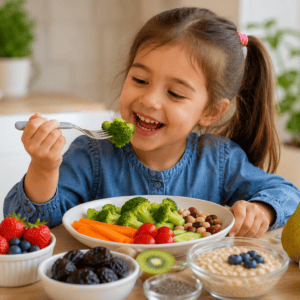
Once significant stool retention has been addressed, nutrition becomes an important part of preventing recurrence.
Helpful foods may include:
- Pears
- Prunes
- Peaches and plums
- Kiwi
- Berries
- Oatmeal
- Beans and lentils
- Vegetables
- Chia or ground flax when age-appropriate
- Other whole foods naturally rich in fibre
For some children, prunes or prune purée can be a particularly simple food-based addition.
However, more fibre isn’t always better.
If a child already has substantial retained stool, suddenly adding large amounts of fibre may increase gas, bloating and abdominal discomfort. Fibre should be considered alongside adequate fluids and the overall constipation plan.
3. Looking at Hydration
Adequate fluid intake supports normal stool consistency and helps fibre do its job.
Rather than focusing on one universal number of cups of water, we can consider the child’s age, activity level, diet, weather and overall fluid intake.
For children who rarely ask for water, simply keeping an appealing water bottle readily available and offering fluids regularly throughout the day can help make hydration more automatic.
4. Establishing a Bowel Routine
The digestive tract naturally becomes more active after eating. This is called the gastrocolic reflex.
For children prone to withholding, sitting on the toilet for several relaxed minutes after a meal can help take advantage of this natural signal.
Position matters too.
A child’s feet shouldn’t be left dangling from the toilet. Using a stool so the feet are supported and the knees are comfortably elevated can make it easier to relax and pass stool.
Most importantly, toilet time should remain calm and non-punitive.
Praise the behaviour—sitting and trying—rather than making praise or rewards dependent on producing a bowel movement.
5. Encouraging Daily Movement
Physical activity is another simple part of supporting normal digestive function.
Running, climbing, playing outside, swimming, dancing and simply being active throughout the day can all be incorporated into a child’s routine.
For a child who spends a lot of time sitting, increasing everyday movement may be one useful part of a broader constipation plan.
6. What About Probiotics?
Parents frequently ask whether a probiotic might help when their child is constipated.
The answer is more nuanced than simply choosing a bottle labelled “kids’ probiotic.”
Research on probiotics for childhood constipation has varied, and different probiotic strains can have different effects. More recent pediatric constipation guidelines suggest that certain specific probiotic and synbiotic combinations may be considered, although the evidence continues to develop.
This is one area where a naturopathic doctor can help parents navigate the enormous number of children’s supplements available.
Rather than choosing a probiotic based solely on the number of “billions” listed on the front of the bottle, we can consider:
- The specific probiotic strains
- Research relevant to the child’s concern
- The amount provided
- The child’s age
- Powder, chewable, liquid or capsule options
- Added sugars, sweeteners and other ingredients
- Storage requirements
- Other digestive symptoms
- Whether a probiotic is even necessary
Naturopathic doctors also have access to professional-grade supplement brands, including products specifically formulated to be easier for children to take.
The same principle applies when selecting magnesium, fibre products and other nutritional supplements.
A product is only useful if the child will actually take it.
For a young child who refuses capsules, for example, a powder or liquid may be much more practical. For an older child, a chewable or capsule may be easier.
An ND can help parents compare formulations and select an appropriate, child-friendly option rather than buying several products through trial and error.
Importantly, probiotics aren’t a substitute for adequately treating significant stool retention or fecal impaction. They may be one supportive consideration within a broader plan rather than the primary treatment for every constipated child.
7. Looking for Contributors When Constipation Keeps Returning
If constipation repeatedly returns despite appropriate treatment, it’s worth asking why.
Depending on the child’s history and symptoms, a naturopathic doctor may consider whether factors such as diet, low fluid intake, withholding, medications or supplements, changes in routine, stress, thyroid function or other digestive concerns could be contributing.
Persistent constipation, poor growth, significant abdominal symptoms or other concerning findings may warrant additional assessment through the child’s family doctor, pediatrician or pediatric gastroenterologist.
The goal isn’t to order extensive testing on every constipated child.
It’s to recognize when a common case of functional constipation isn’t following the expected pattern and deserves a closer look.
8. Tracking Progress
Parents don’t have to rely on memory when trying to decide whether things are improving.
A simple bowel diary can record:
Frequency + approximate amount + Bristol stool type + pain or withholding
The Bristol Stool Chart is an especially helpful visual reference for parents and children learning to recognize and describe stool consistency.
Over several weeks, this gives parents and healthcare providers a clearer picture of whether treatment is actually producing soft, comfortable and complete bowel movements.
When Should Childhood Constipation Be Medically Assessed?
Most childhood constipation is functional, meaning there isn’t an underlying disease causing it.
However, some symptoms warrant further medical assessment.
Speak with your child’s healthcare provider if constipation is persistent, severe, repeatedly returns despite treatment, causes significant pain, affects appetite or growth, or is associated with frequent stool accidents.
More urgent assessment is particularly important when there are concerning features such as:
- Constipation beginning in the first weeks of life
- Delayed passage of meconium after birth
- Significant abdominal distension with vomiting
- Blood in the stool that isn’t readily explained by a small fissure
- Poor growth or unexplained weight loss
- Persistent vomiting
- Significant weakness or neurological symptoms
- A child who appears acutely unwell
These situations require appropriate medical evaluation rather than simply increasing fibre, magnesium or other laxatives at home.
The Bottom Line
A child can poop every day and still be constipated.
Frequency is only one part of healthy bowel function.
Small or incomplete bowel movements, very large stools, withholding, abdominal discomfort, overflow soiling, reduced appetite and emotional or behavioural changes can all provide important clues.
When significant stool retention has developed, treatment may involve two distinct phases: clearing retained stool and then keeping bowel movements consistently soft enough to prevent the problem from building up again.
Magnesium citrate and magnesium oxide are among the osmotic approaches that may be considered as part of individualized naturopathic care. Nutrition, hydration, toileting habits, movement and, in selected children, appropriately chosen probiotics or other supplements may provide additional support.
Most importantly, successful constipation treatment isn’t simply about making a child poop.
It’s about restoring comfortable, predictable and complete bowel movements so eating, playing, sleeping, going to school and using the bathroom can feel normal again.
Looking for Support With Your Child’s Digestive Health?

At Hudson Integrative Healthcare, our naturopathic doctors work with families to assess digestive concerns including constipation, abdominal discomfort, stool irregularities and nutritional concerns.
We can help parents better understand their child’s bowel patterns, explore diet and lifestyle contributors, navigate child-friendly professional-grade supplements when appropriate, and develop an individualized treatment plan.
When medical investigation is needed, naturopathic care can also complement care from your child’s family doctor, pediatrician or pediatric gastroenterologist.
Naturopathic doctor appointments are available in person at Hudson Integrative Healthcare, 7 King St. East in Stoney Creek, Ontario, as well as by telemedicine throughout Ontario.
This article is for educational purposes only and is not intended to diagnose or treat constipation in an individual child. Pediatric laxatives and therapeutic amounts of magnesium should be used with appropriate healthcare guidance. Children with severe, persistent or concerning symptoms should receive medical assessment.
Book Online