
Back-to-School Colds and Flu: Early Signs You May Be Getting Sick
Written by Dr. Melanie Hudson, ND
Edited for Hudson Integrative Healthcare
Back-to-school season often brings more than new routines, packed lunches and busy mornings.
Once children return to classrooms, daycare, sports and other group activities, many families also notice the return of runny noses, sore throats, coughs and respiratory infections circulating through the household.
Sometimes an illness arrives dramatically. Other times, it begins so subtly that you wonder:
“Are they actually getting sick?”
Maybe there is a slightly irritated throat. A few unusual sneezes. A nose that suddenly starts running. Watery or glassy eyes. Or a child who seems just a little more tired than usual.
These can be some of the earliest signs of a respiratory infection, before the more recognizable congestion, cough, fever or malaise develops.
Recognizing these early changes can help families understand what may be happening, monitor symptoms appropriately and reduce the chance of spreading an infection to others.
What Is an Upper Respiratory Tract Infection?
An upper respiratory tract infection, often abbreviated as URTI or URI, affects areas such as the:
- Nose
- Nasal passages
- Sinuses
- Mouth
- Throat
- Upper airways
Most are caused by viruses.
The common cold can be caused by many different viruses, while influenza, RSV, COVID-19 and other respiratory viruses can produce overlapping symptoms. Because of this, it isn’t always possible to identify the specific virus based on symptoms alone.
Colds tend to develop more gradually, while influenza is more likely to begin suddenly and cause stronger whole-body symptoms.
What Are the Earliest Signs of a Cold?

The first signs may be surprisingly mild.
Watch for:
- Scratchy, dry or irritated throat
- Mild sore throat
- New clear or watery runny nose
- Sneezing
- Nasal irritation or tickling
- Watery or glassy-looking eyes
- Mild headache
- Fatigue or feeling “off”
- Reduced appetite
- Tender or swollen glands in the neck
Young children may not be able to explain how they feel. Instead, they may become quieter, clingier, irritable, sleepy, less interested in playing or less interested in eating.
Sometimes parents simply recognize that familiar look and think:
“Something is coming.”
Why Do the Glands in the Neck Swell?
The “glands” people commonly notice under the jaw or along the neck are usually lymph nodes.
Lymph nodes are part of the immune system. During an infection involving the nose or throat, nearby lymph nodes can become more active and temporarily feel enlarged or tender.
We’ll explore this in more detail in our upcoming article:
Immunology 101: Ever Wonder How Your Immune System Actually Works?
When Does Someone Become Contagious?
After exposure to a respiratory virus, there is usually an incubation period while the infection becomes established.
Initially, the person may feel completely normal.
As the earliest symptoms begin—perhaps a scratchy throat, several unusual sneezes or a newly runny nose—the person may still not recognize that they are becoming sick.
However, contagiousness can already be underway before illness feels obvious.
That does not mean every healthy-looking person should be assumed to be contagious. Rather, the earliest symptoms of an infection can overlap with an important period of transmission.
For example, someone who is still playing, eating normally and has no fever may nevertheless already be spreading virus through respiratory secretions if those first sniffles and sneezes represent the beginning of an infection.
Fever Is Not Required
A person does not need to have a fever to be contagious.
Many respiratory infections never produce a significant fever, and even influenza does not cause fever in everyone.
So instead of waiting for someone to look obviously ill, pay attention to new symptoms that are unusual for that person.
As Symptoms Become More Obvious

Over the next day or two, early symptoms may develop into:
- Increasing nasal congestion
- More frequent sneezing
- Sore throat
- Headache
- Watery or glassy eyes
- Swollen or tender lymph nodes
- Fatigue
- Body aches
- Reduced appetite
- Fever or chills in some people
- A general feeling of being unwell
That overall feeling of being tired, uncomfortable and simply not yourself is called malaise.
Young children may express this through crankiness, sleepiness, clinginess or decreased interest in eating and playing.
Why Does a Runny Nose Become Congested?
Early in an infection, nasal discharge may be clear and watery.
As inflammation and mucus production increase, the nose often becomes more congested and secretions may become thicker.
This can cause:
- Blocked nasal passages
- Mouth breathing
- Frequent nose blowing
- Sinus or facial pressure
- Headache
- Throat irritation
- Increasing cough
What If the Mucus Turns Yellow or Green?
Colour alone does not tell you whether an infection is viral or bacterial.
Nasal secretions commonly become thicker and change colour during an ordinary viral respiratory infection.
The overall pattern—how long someone has been sick, whether they are improving and whether new or worsening symptoms appear—is more informative than mucus colour alone.
Post-Nasal Drip, Cough and Chest Congestion

As nasal secretions increase, mucus may drain down the back of the throat. This is known as post-nasal drip.
It can cause:
- Throat clearing
- A sensation of mucus in the throat
- Raspy or irritated throat
- Coughing when lying down
- Increased coughing overnight
- A wet-sounding cough
A wet-sounding cough does not automatically mean the infection has reached the lungs. Significant nasal congestion and post-nasal drainage can make a child sound very “chesty.”
However, some respiratory infections can also involve the lower airways and cause a deeper cough, chest congestion or increased respiratory secretions.
More concerning signs include:
- Difficulty breathing
- Rapid or laboured breathing
- Wheezing
- Grunting
- Retractions around the ribs
- Chest pain
- Significant or worsening fever
These symptoms warrant medical assessment.
Cold vs Flu: What’s the Difference?
Although we commonly say “cold and flu season,” influenza is not simply a more severe cold.
A cold usually develops more gradually
Common symptoms include:
- Runny nose
- Sneezing
- Congestion
- Sore throat
- Cough
- Mild headache
- Mild body aches
- Fatigue
Influenza often begins more suddenly
It is more likely to cause:
- Fever
- Chills
- Significant fatigue
- Headache
- Muscle and body aches
- Cough
- Loss of appetite
- A sudden feeling of being quite unwell
Children may also experience nausea, vomiting or diarrhea with influenza.
There is still considerable overlap, so symptoms alone may not always identify the specific infection.
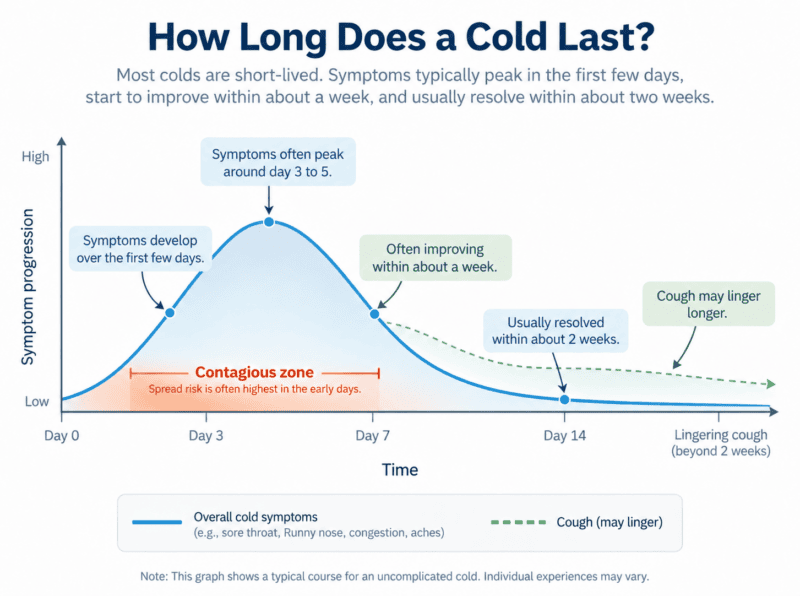
How Long Does a Cold Last?
There is no exact timeline that applies to everyone.
A typical uncomplicated cold often:
- Develops over the first few days
- Begins improving within about a week
- Resolves within approximately two weeks
A cough may linger after other symptoms improve because irritated airways can take longer to settle.
Watch the Pattern, Not Just One Symptom
One of the most useful things to monitor is how the illness is changing.
Someone who is gradually improving is different from someone who begins to recover and then becomes significantly worse.
Seek further assessment for symptoms such as:
- Significant ear pain
- Severe sinus or facial pain
- New or worsening high fever
- Increasing lethargy
- Worsening chest symptoms
- Difficulty breathing
- Signs of dehydration
Call 911 for severe breathing difficulty or another medical emergency.
Parents should also trust their instincts. If a baby or child looks substantially more unwell than you would expect from an ordinary cold, seek medical advice.

What About School and Daycare?
This can be one of the hardest practical decisions for parents.
A child may have only mild early symptoms and still seem energetic enough to attend school. However, those first sniffles, sneezes or throat symptoms may already represent the contagious stage of an infection.
Current local public-health guidance recommends staying home when sick, even when respiratory symptoms are mild.
Other measures that help reduce spread include:
- Covering coughs and sneezes
- Frequent handwashing
- Cleaning commonly touched surfaces
- Improving indoor ventilation
- Avoiding close contact with others while actively ill
The important message is that “no fever” and “still playing” do not necessarily mean an infection is not underway.
The Takeaway: Learn to Recognize the Beginning
Respiratory infections do not always begin dramatically.
They may start with:
An irritated throat.
A few unusual sneezes.
Clear nasal discharge.
Glassy eyes.
Tender glands.
Or simply feeling a little off.
Over the following days, symptoms may develop into congestion, headache, fever, malaise, decreased appetite, post-nasal drip and coughing before gradually resolving.
Recognizing these early changes can help you monitor the illness appropriately and be more mindful about spreading respiratory infections to others.
And if you’ve ever wondered why your nose runs, why your lymph nodes swell, why fever develops or how your body remembers viruses it has encountered before, that’s what we’ll explore next.
Coming Next: Immunology 101 — Ever Wonder How Your Immune System Actually Works?
Looking for Support During Cold and Flu Season?
If you or your child experience frequent illnesses, prolonged symptoms, nutritional concerns or questions about overall health, a naturopathic doctor can help review the broader picture and determine whether additional assessment may be appropriate.

It is also common for patients of our naturopathic doctors to book same-day phone or video telemedicine appointments, when availability allows, during the early stages of a cold or respiratory infection. These visits can be used to review current symptoms, discuss what to watch for, and go over which supplements or supportive measures may be appropriate and safe based on age, medications, medical history and the specific situation.
This can be especially helpful when you already have supplements at home but are unsure what to use, what dose is appropriate, what can be combined safely or whether a product should be avoided.
Prefer an In-Person Assessment?
When availability allows, patients can also book a focused in-person naturopathic visit for an acute concern, similar to the type of short assessment someone might seek at a walk-in clinic.

Depending on the symptoms, your naturopathic doctor may perform an appropriate focused physical examination, such as:
- Listening to the lungs and breathing sounds
- Looking in the ears
- Examining the throat
- Checking lymph nodes
- Taking temperature, blood pressure or other relevant vital signs
- Reviewing the pattern and progression of symptoms
This can help determine whether symptoms appear consistent with an uncomplicated respiratory infection, whether supportive care may be appropriate, or whether further medical assessment, testing or urgent care is needed.
Naturopathic doctors do more than discuss supplements. Physical examination, clinical assessment and knowing when to refer for additional medical care are also important parts of naturopathic practice.
Hudson Integrative Healthcare
Stoney Creek, Ontario
Naturopathic doctor appointments are available in person at our Stoney Creek clinic and by phone or video telemedicine throughout Ontario.
This article is intended for general educational purposes and does not replace individualized medical assessment, diagnosis or emergency care.