Food Sensitivity Testing: Understanding the LifeLabs RMA FST™ IgG Test
Do certain foods seem to leave you feeling bloated, uncomfortable, tired or just generally off — but you’re having trouble figuring out which foods might be involved?
Food reactions aren’t always straightforward. Some symptoms happen quickly after eating, while others may be difficult to connect to a particular meal or ingredient.
This is one reason patients often ask our naturopathic doctors about food sensitivity testing.
At Hudson Integrative Healthcare, our naturopathic doctors can order the Rocky Mountain Analytical (RMA) FST™ IgG Food Sensitivity Test through LifeLabs, with Basic+, Vegetarian+ and Enhanced+ panels available depending on the foods you regularly eat.
But before ordering the test, it’s important to understand what food sensitivity testing measures, what it can’t tell us on its own, and what we actually do with the results.
Food Allergy, Food Intolerance and Food Sensitivity Are Not the Same Thing
Patients often use these terms interchangeably, but they can describe very different processes.
A food allergy typically involves an IgE-mediated immune response. Reactions can include hives, itching, swelling, vomiting, wheezing or, in severe cases, anaphylaxis.
A food intolerance doesn’t necessarily involve an immune response at all. Lactose intolerance, for example, results from insufficient lactase enzyme activity. The LifeLabs guide specifically notes that lactose intolerance is different from an IgG response to milk proteins.
The RMA FST™ instead measures food-specific IgG antibodies.
If you have a known or suspected food allergy — particularly if you’ve experienced hives, swelling, difficulty breathing or another immediate reaction — an IgG food sensitivity test is not a substitute for appropriate allergy assessment. A food that does not produce an IgG response should never be assumed to be safe for someone with a known IgE-mediated allergy.
Similarly, food sensitivity testing does not diagnose celiac disease. If your symptoms or history suggest celiac disease, appropriate celiac testing should be considered separately.
What Is the LifeLabs RMA FST™?
The RMA FST™ is a blood test that measures food-specific IgG antibody levels against a variety of food antigens.
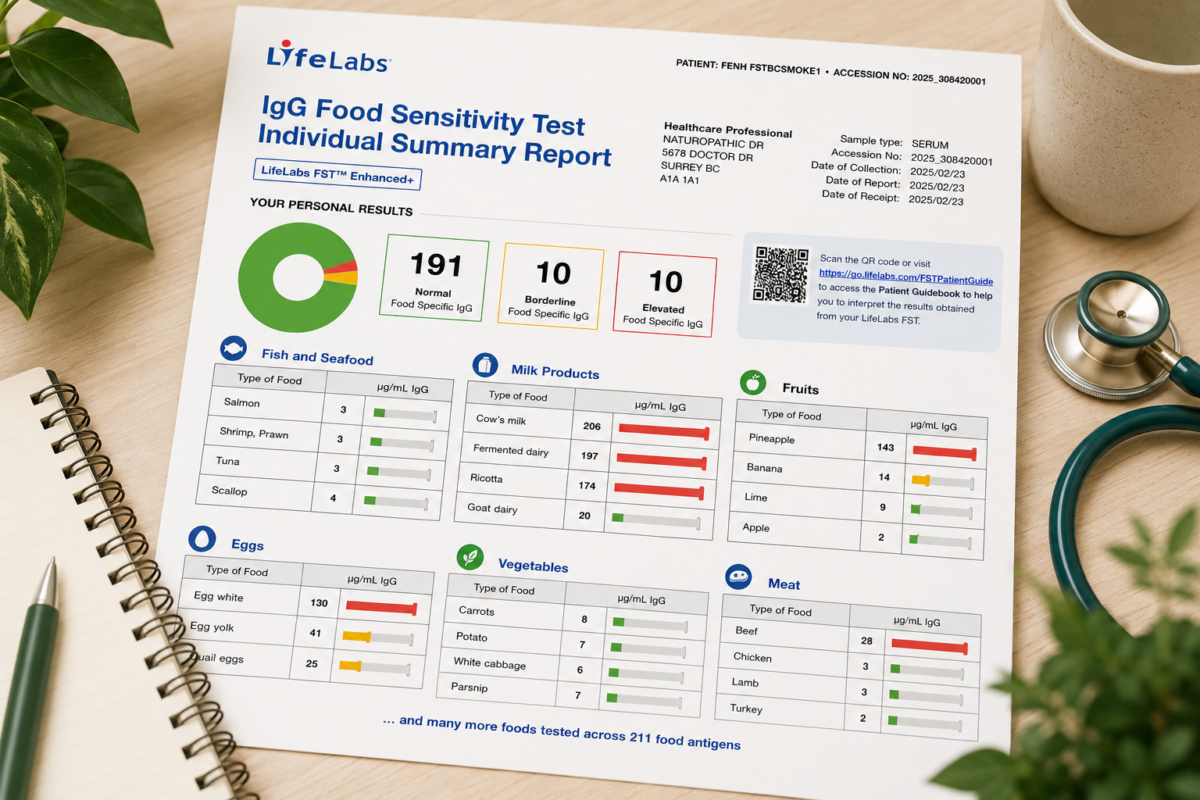
The resulting report categorizes foods according to their measured IgG response:
Normal — the result falls below the reference range
Borderline — the result is moderately elevated but remains below the threshold classified as elevated
Elevated — the result exceeds the lower limit for the elevated category.
Rather than treating this report as a stand-alone diagnosis, our naturopathic doctors can consider it as one piece of information within a broader clinical assessment.
That distinction matters.
LifeLabs’ own patient guide notes that not every food with an increased IgG level will necessarily cause symptoms. The next step is determining which results may actually be clinically relevant to the individual patient.
In other words, an elevated result doesn’t automatically mean that a food is causing your symptoms or that you should never eat that food again.
Why Might a Naturopathic Doctor Consider Food Sensitivity Testing?
 Patients often ask us about food sensitivity testing when they have persistent symptoms and wonder whether something in their diet could be contributing.
These conversations may come up when we’re investigating concerns such as:
- Bloating, gas or abdominal discomfort
- Changes in bowel movements
- IBS-type digestive symptoms
- Skin concerns
- Headaches or migraines
- Joint or muscle discomfort
- Fatigue
- Feeling unwell after certain meals
- Difficulty identifying which foods seem to aggravate symptoms
Sometimes a carefully designed elimination and reintroduction diet may be appropriate without testing. In other situations, an ND and patient may decide that food sensitivity testing could provide additional information to help guide a more structured dietary investigation.
What About Food Sensitivities, Gut Integrity and “Leaky Gut”?
 This is something we talk about frequently with patients.
Your gastrointestinal tract isn’t simply a tube that digests food. The intestinal lining also acts as an important barrier between the contents of the digestive tract and the rest of the body.
Intestinal permeability is a real physiological process, and changes in this barrier are being investigated in relation to gastrointestinal and systemic health conditions. You may have heard increased intestinal permeability referred to more casually as “leaky gut.”
The LifeLabs FST™ patient guide discusses poor intestinal wall integrity and digestion in relation to food-specific IgG responses and identifies factors such as stress, infections, medications and chronic intestinal diseases as potential contributors to compromised gut integrity.
However, this distinction is important:
An IgG food sensitivity test does not diagnose increased intestinal permeability or “leaky gut.”
We don’t look at an FST™ report and conclude that someone has a damaged intestinal barrier simply because several foods are elevated.
Instead, when assessing gut health, our naturopathic doctors consider the bigger picture — digestive symptoms, bowel function, diet, medications, health history and other laboratory investigations when appropriate.
Food sensitivity results may contribute to that broader conversation, but they aren’t a stand-alone measure of gut integrity.
What About Food Sensitivities and Chronic Health Concerns?
 Sometimes patients interested in food sensitivity testing aren’t primarily experiencing digestive symptoms.
They may be dealing with persistent headaches, skin concerns, fatigue, joint discomfort or another chronic health issue and wonder whether food could be one piece of the puzzle.
This is another situation where interpretation matters.
An elevated food-specific IgG result doesn’t establish that we’ve found the cause of someone’s chronic health concern.
Instead, it may help us develop a more focused question:
If we temporarily change exposure to certain foods, do the patient’s symptoms actually change?
That’s where elimination, reintroduction and careful symptom tracking become particularly useful.
Which LifeLabs FST™ Panel Should I Choose?
 LifeLabs offers three RMA FST™ panel options. The best choice depends on the foods you regularly eat and how broad a panel you and your naturopathic doctor decide would be useful.
| Panel | What’s Included | LifeLabs Price* |
|---|---|---|
| FST™ Basic+ | 101 foods including Candida | $235 |
| FST™ Vegetarian+ | 166 foods including Candida, excluding meat and seafood | $259 |
| FST™ Enhanced+ | 211 foods including Candida | $299 |
*Prices shown are the current LifeLabs test prices provided to our clinic and are subject to change. Hudson Integrative Healthcare adds a small laboratory handling fee at checkout for the administration and processing of laboratory testing.
Importantly, the biggest panel isn’t automatically the best panel for every patient.
The goal is to choose a panel containing foods that are actually relevant to the way you eat.
LifeLabs has created a helpful Which LifeLabs FST™ Panel Is Right for You? checklist. It identifies foods available specifically through the Enhanced+ panel and suggests considering Enhanced+ when you regularly consume four or more foods from the additional list.
Download the LifeLabs Panel Selection Guide
Want to see exactly what’s included before choosing? LifeLabs also provides the complete antigen lists for the different panels:
View the LifeLabs FST™ Antigen Lists
Your naturopathic doctor can review your regular diet, symptoms and goals with you to help determine whether testing is appropriate in the first place and, if so, which panel makes the most sense.
What Does a Food Sensitivity Report Look Like?
After your blood sample is analyzed, you’ll receive a detailed report showing your individual IgG results.
The first page provides an easy-to-read summary showing how many tested antigens fall into the normal, borderline and elevated categories, followed by individual food results throughout the report.
The sample Enhanced+ report, for example, includes categories such as fish and seafood, dairy, eggs, meat, vegetables, fruits, herbs and spices, nuts and seeds, grains and other foods.
Want to see exactly what the results look like before deciding whether to proceed?
View a LifeLabs FST™ Sample Report
What Happens After Food Sensitivity Testing?
 One of the biggest misconceptions about food sensitivity testing is that every elevated food needs to disappear from your diet forever.
That’s not how we want patients to approach their results.
Depending on your symptoms, diet and test findings, your naturopathic doctor may recommend a period of elimination followed by systematic food reintroduction and symptom monitoring.
The LifeLabs Patient Guidebook describes a three-step process:
1. Eliminate
Temporarily remove selected reactive foods while maintaining a varied and nutritionally complete diet.
2. Provoke (Reintroduce)
Foods are subsequently introduced back into the diet individually to determine whether they actually produce symptoms.
3. Monitor
Observe whether symptoms return following reintroduction and use this information to help determine which foods appear clinically relevant.
This helps move the conversation away from:
“My report says I’m sensitive to this food.”
and toward the much more useful question:
“What actually happens when I eat this food?”
LifeLabs Even Includes a Food Reintroduction Symptoms Tracker
This is one of the resources we particularly like.
Page two of the Which Panel Is Right for You? guide contains a printable Food Reintroduction Symptoms Tracker designed to help patients systematically record what happens as foods are introduced back into their diet.
Rather than relying on a vague memory of “I think I felt worse after eating that,” patients can track changes over several days in:
- Digestion and bowel function
- Joint or muscle aches
- Headaches or pressure
- Nasal or chest congestion
- Skin symptoms
- Energy levels
- Sleep
- Other symptoms
The tracker recommends choosing one test food at a time and taking detailed notes about how you feel.
Download the Panel Guide + Food Reintroduction Symptoms Tracker
This gives you and your naturopathic doctor much more useful information to review together at your follow-up appointment.
Why Work With an ND Instead of Just Removing Everything on the Report?
 Because more restriction isn’t necessarily better.
If your report shows numerous borderline or elevated foods, eliminating everything indefinitely without guidance can quickly turn into a very restrictive diet.
Our goal isn’t to leave patients afraid of food or following an unnecessarily limited diet.
Instead, your naturopathic doctor can help interpret the results in the context of your actual symptoms, determine which foods are most appropriate to investigate, develop an elimination strategy when indicated, identify nutritious substitutions, monitor nutritional adequacy and systematically reintroduce foods.
Sometimes the conclusion may even be that a food flagged on the report doesn’t appear to cause symptoms when it’s reintroduced.
That’s useful information too.
What If I Need to Eliminate Common Foods Like Dairy, Eggs or Gluten?
This is another reason we like patients to have access to the LifeLabs Patient Guidebook.
Removing a major food group isn’t always as simple as swapping one ingredient. We also need to think about what nutrients that food was contributing to your diet and where those nutrients will come from instead.
The guide includes practical information about navigating gluten, dairy, eggs and yeast, including common hidden sources and potential food substitutions.
It also includes meal and recipe ideas to help patients navigate dietary changes.
Download the LifeLabs FST™ Patient Guidebook

Food Sensitivity Testing Isn’t Right for Everyone
Not every patient with digestive symptoms or a chronic health concern needs an FST™.
Depending on your symptoms and history, your naturopathic doctor may recommend conventional bloodwork, celiac testing, appropriate food-allergy assessment, other gastrointestinal investigations or simply a carefully designed dietary trial instead.
This is why we generally recommend speaking with your ND before deciding which laboratory test to purchase.
Good testing should help answer a clinical question — not simply generate more data.
Helpful LifeLabs FST™ Resources
If you’re considering food sensitivity testing — or you’ve already received your results — these four resources are worth bookmarking:
- LifeLabs FST™ Patient Guidebook — Understand the test and results and find practical information about elimination, reintroduction, food substitutions and recipes.
Download the Patient Guidebook - Which LifeLabs FST™ Panel Is Right for You? — Compare panel options and see whether the additional foods included in Enhanced+ are relevant to your diet.
Download the Panel Selection Guide - LifeLabs FST™ Antigen Lists — See which individual foods are included in the Basic+, Vegetarian+ and Enhanced+ panels.
View the Complete Antigen Lists - LifeLabs FST™ Sample Report — See how individual food-specific IgG results are presented before you test.
View the Sample FST™ Report
Interested in Food Sensitivity Testing?
Our naturopathic doctors at Hudson Integrative Healthcare can help you determine whether food sensitivity testing is appropriate based on your symptoms, diet and health history.
When indicated, we can order the LifeLabs RMA FST™, help you select the appropriate panel, review and interpret your results, and develop an individualized elimination and food-reintroduction strategy.
Food sensitivity testing is also only one piece of digestive and whole-body health assessment. Depending on your concerns, your ND can discuss other laboratory testing, nutrition, supplementation and lifestyle strategies that may be appropriate for you.

Appointments with our naturopathic doctors are available in person at our downtown Stoney Creek clinic or Ontario-wide by secure phone or video telemedicine.
Hudson Integrative Healthcare
7 King St. East, Unit #1
Stoney Creek, ON
L8G 1J8
Book with one of our naturopathic doctors to discuss whether food sensitivity testing is right for you.