
Immunology 101: Why Kids Get Sick So Often at Daycare — and How Immunity Develops
Written by Dr. Melanie Hudson, ND
Edited for Hudson Integrative Healthcare
If you have young children in daycare, you have probably heard some version of this:
“They’re sick all the time now, but at least they’re building their immune system.”
There is some truth behind that idea — but the way immunity develops is a little more complicated than simply getting sick and becoming “stronger.”
When children start daycare, they are suddenly spending time around many other children and encountering viruses and other microorganisms they may never have been exposed to before. That helps explain why the first months — and sometimes the first few years — of daycare can feel like an endless cycle of runny noses, coughs, fevers and other infections.
Each new exposure gives the immune system an opportunity to recognize what it is dealing with, mount a response and, in many cases, create immune memory that may help it respond more efficiently if it encounters the same pathogen again.
But this does not mean that repeated illness makes the entire immune system universally stronger or that children need to get sick in order to develop a healthy immune system.
To understand what is really happening, it helps to look at two major parts of our immune defence: innate immunity and adaptive immunity.
Innate vs. Adaptive Immunity: What’s the Difference?
Your immune system does not wait several days before doing anything about an infection.
In fact, some of your most important immune defences are already present and ready to respond.
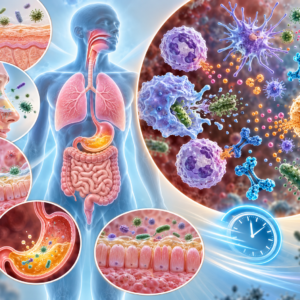
Innate Immunity: Your Immediate First Line of Defence
The innate immune system is the body’s rapid-response system.
It begins responding within minutes to hours when it detects something potentially harmful.
Innate immunity includes physical barriers such as:
- Skin
- The lining of the nose, lungs and digestive tract
- Mucus
- Stomach acid
- Protective secretions
It also includes immune cells and proteins such as:
- Neutrophils
- Macrophages
- Dendritic cells
- Natural killer cells
- Complement proteins
- Cytokines and other inflammatory signalling molecules
These defences recognize broad patterns commonly associated with viruses, bacteria and other microorganisms.
They do not need to have encountered that exact virus before.
This is one of the reasons inflammation can begin very quickly during an infection. Fever, increased mucus production, swollen lymph nodes and fatigue can all occur as immune signalling ramps up.
The innate immune system also plays an important role in activating the next phase of defence: the adaptive immune system.
Adaptive Immunity: A Targeted Immune Response
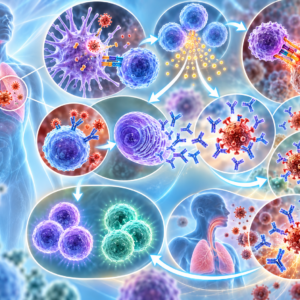
The adaptive immune system is much more specific.
Instead of recognizing general characteristics of microorganisms, adaptive immune cells learn to recognize particular antigens — molecular features associated with a particular pathogen.
Two major players are:
B Cells
B lymphocytes can develop into plasma cells that produce antibodies.
Antibodies bind to particular antigens and can help:
- Neutralize viruses or toxins
- Prevent pathogens from entering cells
- Mark pathogens for destruction
- Recruit other parts of the immune system
T Cells
T lymphocytes perform several different jobs.
Some help coordinate immune responses, while others recognize and destroy infected cells.
Importantly, both B and T cells can also develop into memory cells.
These memory cells are one of the most remarkable features of the immune system.
Once the infection has passed, some immune cells remain behind with a biological “memory” of that antigen. If the same pathogen — or a sufficiently similar one — appears again, the immune system can respond much more efficiently.
What Happens the First Time You’re Exposed to a Virus?
Imagine a child encounters a virus they have never seen before.
Their immune system is not starting from zero.
Their innate immune system responds immediately, attempting to contain the infection while information about the pathogen is passed along to the adaptive immune system.
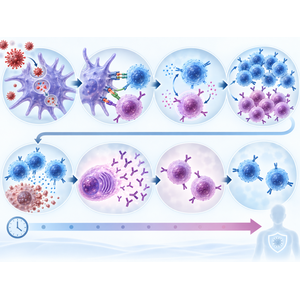
Dendritic cells and other antigen-presenting cells process pathogens and present pieces of them to T cells, helping activate the adaptive immune response. B cells can recognize specific antigens directly and, with appropriate signalling, become activated and begin multiplying.
Those adaptive immune cells then need time to:
- Recognize the antigen.
- Activate the correct immune cells.
- Multiply those cells.
- Produce specialized effector cells.
- Begin producing meaningful amounts of antibody.
- Create memory cells for future encounters.
That process takes time.
A typical first adaptive immune response develops over several days. For many antigens, the initial antibody response has a lag of approximately 7 to 10 days, although the exact timing varies considerably depending on the pathogen, route of exposure, age, immune status and other factors.
Antibodies During a First Exposure
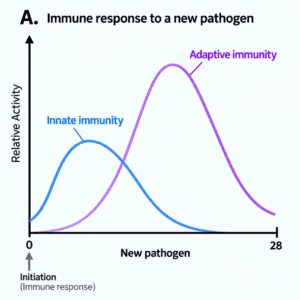
During a classic primary antibody response, IgM antibodies tend to appear first.
Over time, B cells can undergo processes that allow them to produce other antibody types, including higher-affinity IgG antibodies.
A simplified timeline might look something like this:
Minutes to hours:
Innate immunity begins responding.
First few days:
Antigen presentation and activation of B and T cells are underway.
Approximately days 4–7:
Activated adaptive immune cells are multiplying and differentiating.
Approximately days 7–10 and beyond:
A more substantial antigen-specific antibody response may become established.
These ranges are teaching approximations rather than a stopwatch. Different infections can behave very differently.
This delay helps explain an important point:
You can become quite symptomatic before your adaptive immune system has finished building its most targeted response.
Your innate immune system is trying to hold the line while adaptive immunity catches up.
What Happens the Second Time You’re Exposed?
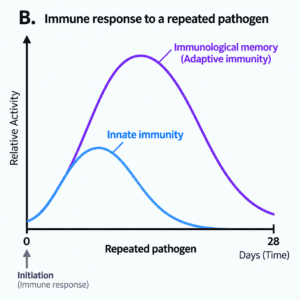
Now imagine that same child encounters the same antigen again several months later.
This time, the immune system has memory.
Instead of beginning predominantly with rare, naïve B and T cells, the body may already have antigen-specific memory B cells and memory T cells available.
The response can therefore happen much more quickly.
During a secondary immune response, antigen-specific memory cells can begin responding much sooner — often within the first few days — followed by a more rapid rise in antibody production.
The secondary antibody response also tends to:
- Develop more rapidly
- Produce more antibody
- Produce antibodies that bind their targets more effectively
- Rely more heavily on antibodies such as IgG rather than starting primarily with IgM
This is immunological memory.
It is also one of the immunological principles used in vaccination: exposing the immune system to a particular antigen, or information representing that antigen, can promote immune memory before a future encounter.
However, understanding that basic immunological mechanism is different from evaluating the effectiveness, benefits, limitations, risks, timing and safety of any particular vaccine. Those are much broader questions that depend on the specific vaccine, the infection being considered, the individual patient and the available evidence. They deserve thoughtful, in-depth discussion and are beyond the scope of this introductory article.

So, Does Daycare Actually “Build the Immune System”?
This is where the answer becomes:
Yes — but not quite in the way people often mean it.
Children entering daycare suddenly encounter many other children, shared toys, respiratory droplets, hands, surfaces and microorganisms.
For a young child who has spent most of their life primarily around their immediate family, this can represent a dramatic increase in the number of infectious organisms they encounter.
Unsurprisingly, illnesses often increase.
Children may experience substantially more colds during their first year of group childcare than children cared for at home without similar exposure. Respiratory illnesses also commonly begin decreasing after the initial period of frequent exposure.
So parents are not imagining the classic:
“They started daycare and we’ve been sick ever since.”
There really can be a concentrated period of new exposures.
Daycare Exposures Can Create Immune Memory — Not a Universally ‘Stronger’ Immune System
Here is the distinction that matters.
If a child encounters Virus A, develops an adaptive response and creates memory cells against Virus A, they may respond much faster the next time they encounter Virus A.
But that does not necessarily give them immunity to:
- Virus B
- Virus C
- A completely different type of bacteria
- Every future respiratory infection
Adaptive immunity is highly antigen specific.
That is especially relevant when discussing the common cold.
“Colds” are not one disease caused by one virus. Many different viruses and viral strains can produce similar cough, congestion and runny nose symptoms.
So a toddler can successfully develop immune memory to one virus and still encounter a completely unfamiliar virus the following week.
From the parent’s perspective, it can feel like:
“Didn’t we just finish being sick?”
From the immune system’s perspective, it may be an entirely new assignment.
Does Getting Sick Earlier Mean Children Will Get Sick Less Later?

This is another area where the common explanation can become too simplistic.
It is tempting to think of childhood infections as a fixed checklist:
Get them all over with in daycare now, and there will be fewer illnesses later.
Research does not support such a simple trade-off.
Some studies have found that children in daycare experience more infections during the early years and that differences between childcare and home-care groups become smaller by school age.
However, large population studies have also found that earlier childcare exposure does not necessarily result in fewer total infections later in childhood.
So rather than saying:
“Daycare makes kids sick now so they won’t get sick later,”
a more accurate statement would be:
Daycare increases exposure to infectious organisms. Those exposures can create specific immune memory, and children often experience fewer respiratory illnesses after the initial high-exposure period. But purposely accumulating infections is not required to develop a healthy immune system, and earlier illness does not guarantee fewer total illnesses later.
What About Siblings?
Daycare is not the only place children encounter new microorganisms.
Older siblings can bring home plenty of viruses from:
- School
- Daycare
- Sports
- Playgroups
- Birthday parties
- Community activities
This is why younger siblings may already have substantial exposure before they ever enter childcare themselves.
The immune system continuously interacts with microorganisms throughout everyday life.
Children do not need deliberate exposure to illness for their immune systems to learn.
Is Frequent Illness in Daycare a Sign of a Weak Immune System?
Usually, frequent uncomplicated respiratory infections in young children do not automatically indicate poor immune function.
Healthy young children commonly experience numerous respiratory infections each year, and childcare can increase that number further.
What matters is not simply how many times a child gets sick.
Clinicians may also consider:
- How severe infections are
- How long they last
- Whether the child recovers normally between illnesses
- Whether infections are unusually difficult to treat
- Whether there are recurrent serious bacterial infections
- Whether infections require repeated hospitalization
- Growth and development
- Nutrition
- Sleep
- Other medical conditions
A child who catches several ordinary daycare colds but recovers normally is a very different situation from a child experiencing unusually severe, persistent or recurrent infections.
Those patterns should always be discussed with the child’s healthcare provider.
A Better Way to Think About the Immune System

Instead of picturing immunity as a muscle that simply becomes stronger every time you get sick, think of it more like an enormous biological recognition library.
Your innate immune system is the security team that is always on duty.
It recognizes suspicious patterns and responds quickly.
Your adaptive immune system is the specialist team.
When it encounters something new, it studies the threat, develops highly targeted tools and saves information about that encounter.
When the same threat appears again, the immune system can retrieve that information and respond much more rapidly.
Daycare introduces a lot of new entries into that library very quickly.
That helps explain both sides of the daycare experience:
Why children can seem to be sick constantly when they first enter group care — and why some of those same infections become easier for their immune system to recognize later.
The Takeaway
Your child’s immune system is working long before antibodies appear.
Innate immunity provides rapid, broad protection beginning almost immediately after exposure.
Adaptive immunity develops a slower but highly targeted response involving B cells, T cells and antibodies.
During a first exposure, developing a meaningful targeted antibody response often takes several days.
After immune memory has formed, a repeat exposure to the same antigen can trigger a much faster and more efficient response.
Daycare provides plenty of opportunities for that immune learning because children encounter many infectious organisms.
However, the goal is not to have children catch as many infections as possible.
Supporting adequate nutrition, sufficient sleep, good hygiene and reducing avoidable transmission remain important parts of children’s overall health.
The immune system will have no shortage of opportunities to learn along the way.
When to Seek Individualized Support
If you or your child seem to be experiencing unusually frequent illnesses, prolonged recovery, concerns about nutrition, fatigue or other ongoing symptoms, an individualized assessment can help determine whether further investigation is appropriate.
The naturopathic doctors at Hudson Integrative Healthcare offer individualized care for children and adults, including assessment of nutrition, lifestyle factors and other health concerns that may influence overall wellbeing and recovery.
Appointments are available in person at our Stoney Creek clinic and through telemedicine across Ontario.
Hudson Integrative Healthcare
7 King St E, Unit 1
Stoney Creek, Ontario L8G 1J7
905-662-0045
This article is intended for general educational purposes and does not replace individualized medical assessment or treatment.