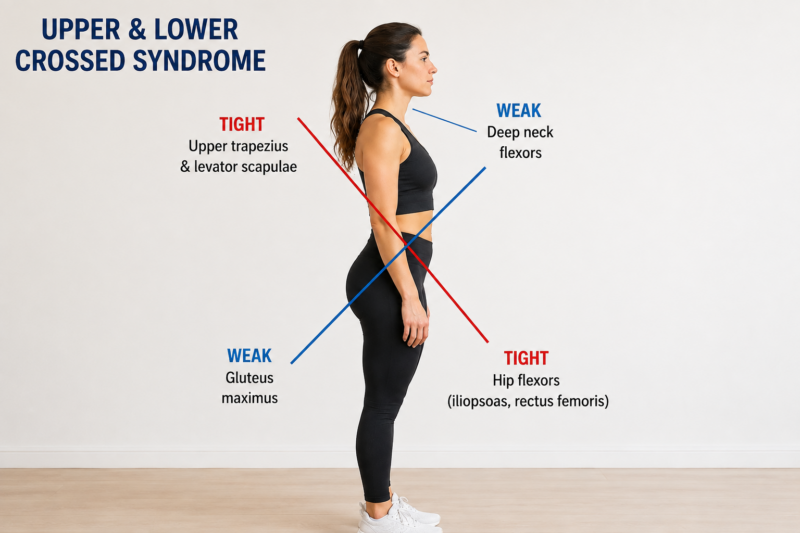
Upper & Lower Crossed Syndrome
Do you find yourself constantly trying to “sit up straight,” only to realize a few minutes later that your head has drifted forward and your shoulders are rounded again?
Maybe your neck and shoulders always feel tight after a day at your computer. Or perhaps it’s your lower back that feels stiff, while the front of your hips feels tight after hours of sitting.
Sometimes these patterns aren’t about one individual muscle or joint. Instead, certain muscles may become tight or overactive while others become weak, inhibited or underused.
Two patterns commonly discussed in musculoskeletal care are called Upper Crossed Syndrome and Lower Crossed Syndrome.
Understanding these patterns can help explain why simply stretching the area that feels tight doesn’t always solve the problem — and why treatment may need to address both mobility and strength.
What Is Upper Crossed Syndrome?

Upper Crossed Syndrome (UCS) describes a common pattern of muscle imbalance involving the neck, shoulders and upper back.
It’s often associated with a forward head position and rounded or forward shoulders.
Think about what happens when you’re working at a computer, looking down at your phone, driving, feeding a baby, or spending hours doing something with your arms in front of you.
Over time, certain muscles may become more dominant and tight while others aren’t being recruited as effectively.
Which Muscles Are Typically Tight?
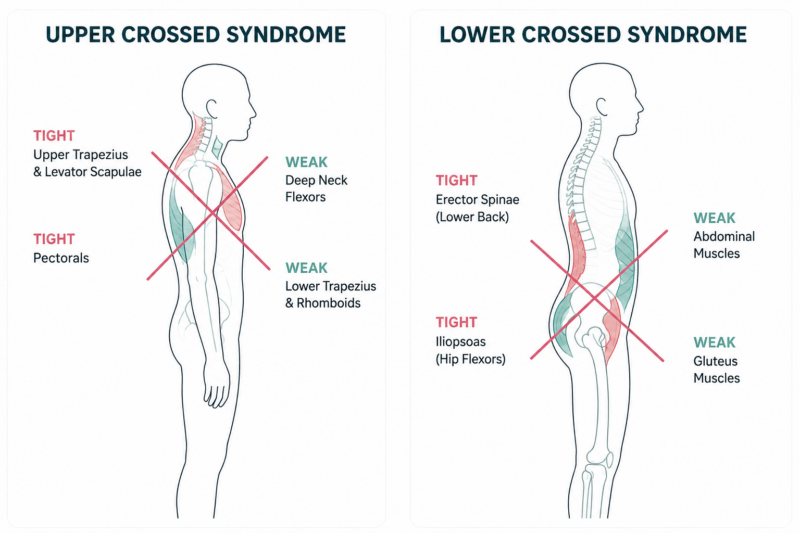
In the classic Upper Crossed Syndrome pattern, commonly tight or overactive muscles can include:
- Upper trapezius
- Levator scapulae
- Sternocleidomastoid and other neck muscles
- Pectoralis major and minor muscles across the chest
At the same time, muscles that help stabilize the neck and shoulder blades may become relatively weak or inhibited, including:
- Deep neck flexors
- Middle and lower trapezius
- Rhomboids
- Serratus anterior
When you look at these muscle groups across the body, the areas of tightness and weakness form a rough “X” or cross — hence the name Upper Crossed Syndrome.
What Might Upper Crossed Syndrome Feel Like?
Not everyone with forward head or rounded shoulder posture will experience pain.
However, when this pattern is accompanied by altered movement, muscle tension or reduced mobility, some people may notice:
- Neck pain or stiffness
- Tight shoulders
- Upper back discomfort
- Tension at the base of the skull
- Headaches associated with neck tension
- Reduced neck or shoulder mobility
- A feeling of constantly needing to stretch the neck
- Rounded shoulders
- Forward head posture
- Shoulder blade discomfort
- Fatigue through the neck and upper back after sitting or computer work
One clue can be that the muscles that feel the tightest aren’t necessarily the muscles that need strengthening.
Your upper trapezius, for example, may already be working overtime trying to compensate for muscles around the shoulder blade that aren’t contributing as effectively.
What Is Lower Crossed Syndrome?

A similar pattern can occur around the pelvis, hips and lower back.
This is known as Lower Crossed Syndrome (LCS).
In the classic pattern, muscles around the front of the hips and lower back tend to become tight or overactive, while the abdominal and gluteal muscles may become relatively weak or inhibited.
Which Muscles Are Typically Tight?
Commonly tight or overactive areas may include:
- Hip flexors
- Iliopsoas
- Rectus femoris
- Muscles of the lower back
Meanwhile, relatively weak or inhibited muscles may include:
- Gluteal muscles
- Deep abdominal and core musculature
This can contribute to changes in the way the pelvis, hips and lumbar spine move and work together.
Some people with this pattern demonstrate an increased anterior pelvic tilt or increased curve through the lower back.
What Might Lower Crossed Syndrome Feel Like?
Again, posture alone doesn’t necessarily mean something is wrong.
But when the muscles and joints aren’t working together efficiently, you may notice:
- Lower back tightness or discomfort
- Tightness through the front of the hips
- Hip discomfort
- Difficulty activating the glutes
- Lower back fatigue with prolonged standing
- Stiffness after sitting for long periods
- Feeling like your hip flexors constantly need stretching
- Difficulty maintaining comfortable posture for extended periods
- Changes in movement during squatting, lifting, walking or exercise
And just like Upper Crossed Syndrome, repeatedly stretching whatever feels tight may provide temporary relief without addressing the whole pattern.
Why Do Some Muscles Become Tight While Others Become Weak?
 Our bodies are remarkably adaptable.
If you repeatedly spend long periods in one position or perform the same movement patterns, your body adapts to what you ask it to do.
For many of us, modern life involves a lot of sitting.
We sit while driving. We sit at work. We look down at phones and laptops. We sit while watching television. And even people who exercise regularly may spend much of the remaining day relatively sedentary.
Other factors can contribute too, including:
- Repetitive work
- Previous injuries
- Exercise or training patterns
- Reduced mobility
- Muscle weakness
- Pregnancy and postpartum changes
- How we lift and carry children
- Workstation ergonomics
- Habitual movement patterns
The answer isn’t to maintain one rigid definition of “perfect posture” all day.
In fact, movement and variety matter.
The goal is to help your body comfortably tolerate the positions and activities required in everyday life.
Why Doesn’t Stretching Alone Always Fix Tight Muscles?
If something feels tight, our natural instinct is usually to stretch it.
And stretching can certainly be helpful.
But consider a muscle that is constantly compensating because another muscle isn’t doing its share of the work.
That muscle may feel tight because it is working too much, not simply because it needs to be stretched.
This is why treatment may include a combination of:
Improving mobility + reducing excessive tension + strengthening underactive muscles + retraining movement patterns.
Research into Upper Crossed Syndrome has found that corrective exercise can improve measures such as forward head and rounded shoulder posture. Treatment programs commonly focus on strengthening or activating underused muscles while addressing muscles that are tight or overactive.
How Can a Chiropractor Help?
Chiropractic care isn’t only about “cracking” the spine.
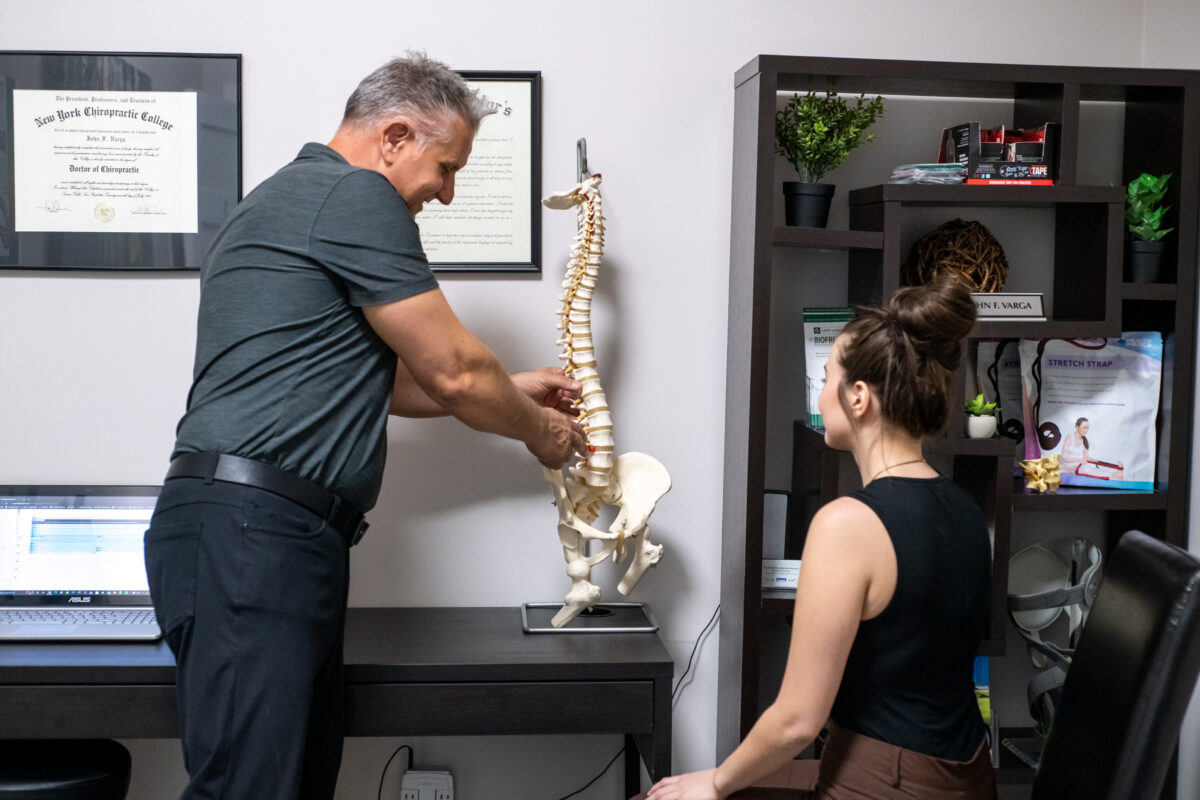
A chiropractor can assess how your joints, muscles and movement patterns are functioning together.
Depending on your individual findings, chiropractic treatment may include:
- Joint mobilization or manipulation
- Soft tissue therapy
- Stretching and mobility work
- Postural assessment
- Ergonomic recommendations
- Strengthening and corrective exercises
- Advice about movement throughout the workday
- Home exercises designed for your specific areas of weakness or restriction
If your neck feels tight, for example, the assessment may look beyond your neck to consider your thoracic spine, shoulders, shoulder blades and surrounding musculature.
Similarly, lower back discomfort may warrant assessment of the hips, pelvis, glutes and core rather than focusing exclusively on the lumbar spine.
How Can an Osteopathic Manual Practitioner Help?
Osteopathic manual practitioners also take a whole-body approach to musculoskeletal function.
Treatment is hands-on and may assess how different regions of the body are moving in relation to one another.
Depending on the individual’s needs, osteopathic manual treatment may include techniques aimed at:
- Improving joint mobility
- Reducing muscular and fascial tension
- Improving movement through restricted areas
- Addressing compensatory movement patterns
- Supporting more comfortable movement throughout the body
This can be particularly helpful when the area where you feel discomfort isn’t the only area contributing to the movement pattern.
For example, someone experiencing neck and shoulder tension may also have restrictions through the thoracic spine or rib cage. Someone experiencing lower back tension may benefit from assessing mobility through the hips and pelvis as well.
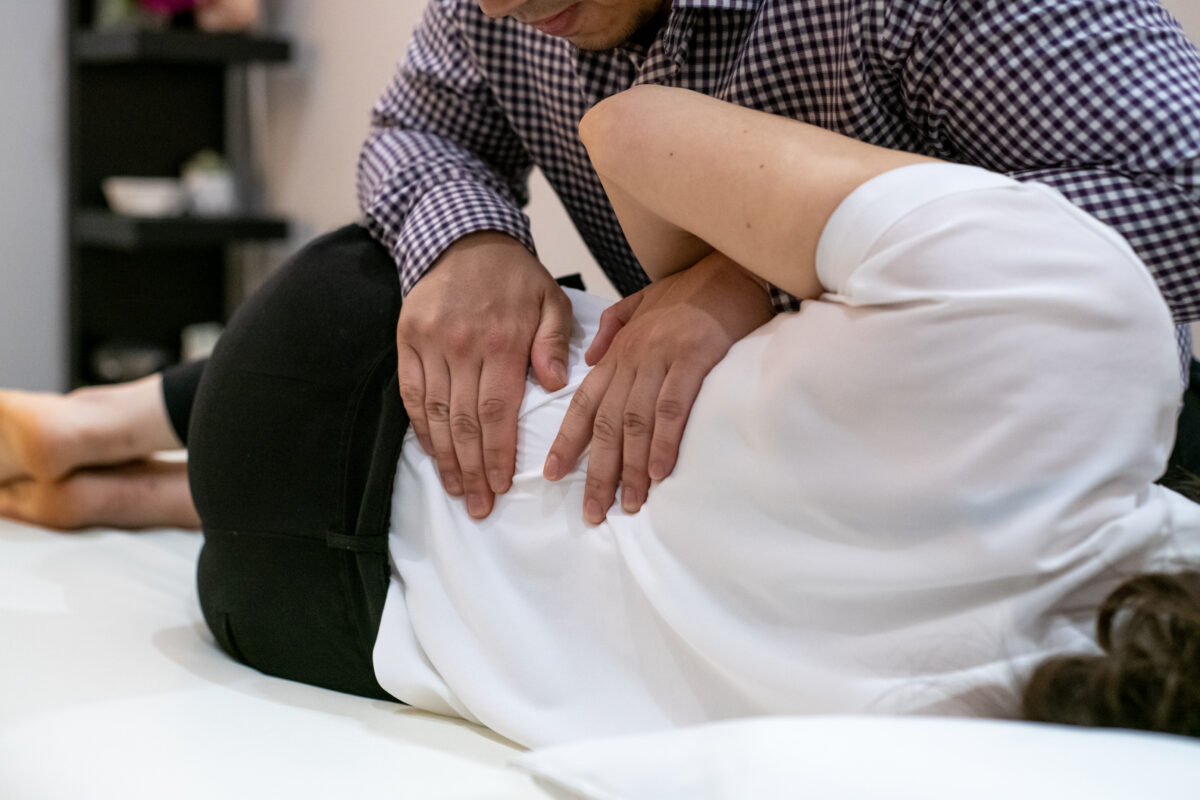
Manual Therapy + Movement: Looking Beyond the Painful Area
Upper and Lower Crossed Syndrome are useful examples of why musculoskeletal treatment doesn’t always focus exclusively on the place that hurts.
- The muscle that feels tight may need mobility work.
- Another muscle may need strengthening.
- A joint may not be moving as comfortably as it could.
- And your workstation, daily habits or exercise routine may be reinforcing the same pattern every day.
That’s why an individualized assessment can be more useful than simply searching online for “the best stretch for neck pain” or “the best stretch for tight hips.”
The goal isn’t to force your body into a picture-perfect posture.
It’s to help you move comfortably, build strength where you need it, improve mobility where you’re restricted, and reduce the amount of unnecessary strain your body experiences throughout the day.
Could Your Posture or Muscle Imbalances Be Contributing to How You Feel?
If you’re frequently experiencing neck tension, rounded shoulders, upper back discomfort, tight hips or lower back stiffness, a musculoskeletal assessment may help determine what’s actually happening.
Our chiropractic and osteopathic manual practitioner team at Hudson Integrative Healthcare can assess your posture, mobility, muscle function and movement patterns and develop an individualized treatment plan based on what they find.
Appointments are available in person at our clinic in downtown Stoney Creek.
Hudson Integrative Healthcare
7 King St. East, Unit #1
Stoney Creek, ON L8G 1J8
Ready to get moving and feeling better? Book an appointment with a member of our chiropractic or osteopathic manual practitioner team today.
Book Online