
The Mental Side of Performance: How Therapy Can Help Athletes, Active Individuals, and High Achievers
Written by Sarah Prashad, RP
Adapted and edited for Hudson Integrative Healthcare
When we think about improving performance, we often focus on what we can see: training harder, getting stronger, improving technique, following a nutrition plan or getting more sleep.
But performance is not only physical.
Whether you are a competitive athlete, recreationally active, returning to exercise after an injury or simply someone who places high expectations on yourself, your mental and emotional wellbeing can play an important role in how you perform, recover and experience your goals.
You can be physically prepared and still find yourself overthinking, doubting yourself, struggling with confidence, fearing mistakes or feeling as though you are never doing enough.
This is where psychotherapy can become an important part of the bigger picture.
Performance Is More Than What Happens in the Body
Athletes and active individuals often spend a significant amount of time preparing their bodies for performance. They train, practise, recover and work on their physical skills.
But what happens mentally can also influence how we approach challenges and how we respond when things do not go according to plan.
Consider an athlete who has trained consistently for months but becomes overwhelmed by nerves before a competition. Someone may perform well during practice but struggle to trust themselves during a game. Another person may be returning from an injury and find themselves afraid to make the same movement again.
These experiences do not necessarily mean someone lacks physical ability, preparation or motivation. Sometimes, the challenge is happening in the mental and emotional space.
Performance can be affected by:
- Performance anxiety or nervousness
- Fear of failure or making mistakes
- Comparing yourself to others
- Difficulty managing pressure
- Negative or overly critical self-talk
- Perfectionism
- Loss of confidence following a setback
- Difficulty staying focused in the moment
- Burnout or emotional exhaustion
- Difficulty balancing sport, school, work, relationships and other responsibilities
Learning to recognize and work with these patterns may help individuals develop a healthier relationship with performance.
What If Trying to Be “Better” Is Actually Getting in the Way?
For many high-achieving individuals, the desire to improve can be a strength.
You care. You are motivated. You set goals. You want to become better than you were yesterday.
But there can be an important difference between healthy striving and perfectionism.
Healthy striving may sound like:
“I want to improve because this is important to me.”
Perfectionism may sound more like:
“If I don’t perform perfectly, I have failed.”
Or:
“If I make a mistake, everyone will notice.”
“I should be further ahead by now.”
“I need to prove that I’m good enough.”
When performance becomes closely tied to self-worth, mistakes can begin to feel much bigger than they actually are.
Instead of seeing a missed shot, slow race, difficult workout, poor grade or disappointing performance as one experience, someone may interpret it as evidence that they are not capable, talented, disciplined or successful enough.
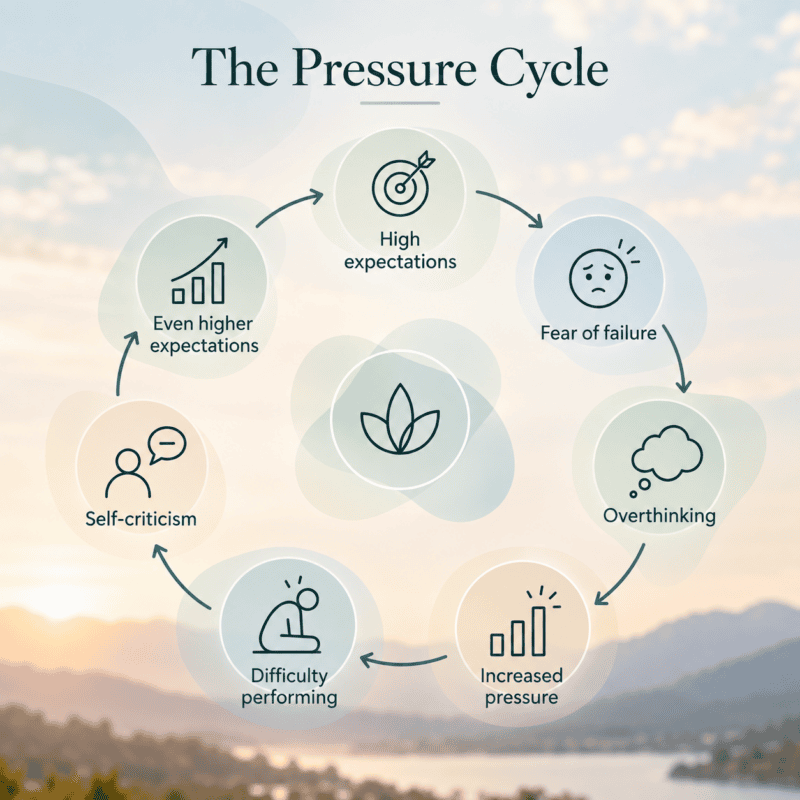
This can create a difficult cycle:
High expectations → fear of failure → overthinking → increased pressure → difficulty performing → self-criticism → even higher expectations
Ironically, the pressure to perform perfectly can sometimes interfere with the very performance someone is trying to improve.
When Your Inner Critic Becomes the Coach
Many athletes and high-achieving individuals are familiar with a loud inner critic.

It may say:
- “You should have done better.”
- “Everyone else is ahead of you.”
- “You can’t afford to make another mistake.”
- “You aren’t working hard enough.”
- “If you take a break, you’re falling behind.”
Some people believe that being hard on themselves is what keeps them motivated.
But motivation does not have to come from criticism.
There is a difference between accountability and self-punishment.
A supportive internal voice can still challenge you while also recognizing that mistakes, setbacks, rest and difficult days are part of being human.
In therapy, individuals can begin to explore where their expectations come from, how they respond to mistakes and whether their internal dialogue is helping them move toward their goals — or keeping them stuck.
Therapy Isn’t Only for When Something Is “Wrong”
One common misconception about psychotherapy is that you need to be experiencing a significant mental health concern before seeking support.
Therapy can certainly help individuals navigate anxiety, depression, burnout, stress, life transitions and other mental health concerns.
But psychotherapy can also provide a space for:
- Personal growth
- Greater self-awareness
- Confidence building
- Managing pressure
- Understanding perfectionistic patterns
- Improving emotional regulation
- Developing healthier ways of responding to challenges
- Exploring identity and self-worth
At Hudson Integrative Healthcare, our psychotherapy services support individuals navigating concerns including anxiety, stress, emotional regulation, overwhelm, burnout, self-worth, identity and life transitions.
How Therapy May Support Athletes and High Achievers
For someone who is active or performance-oriented, therapy may provide an opportunity to explore questions such as:
- Why do I put so much pressure on myself?
- Why does making a mistake feel so difficult?
- Why do I lose confidence after performing poorly?
- Why am I struggling to enjoy something I used to love?
- How can I manage pressure without becoming overwhelmed?
- How can I become more comfortable with uncertainty?
- How can I stay motivated without being so hard on myself?
- What does success actually mean to me?
You do not have to wait until you are struggling significantly to begin asking these questions.
Psychotherapy can be part of a proactive approach to mental and emotional wellbeing, just as training, recovery, nutrition and physical healthcare can be part of supporting the body.
Meet Sarah Prashad, Registered Psychotherapist
Sarah Prashad, RP, is a Registered Psychotherapist with a particular interest in supporting athletes, active individuals and high-achieving individuals navigating the mental and emotional side of performance.
As a former college softball athlete at the University of Michigan–Dearborn, Sarah has firsthand experience with the demands of competitive sport.
She understands that performance is not simply about physical preparation. The pressure to perform, managing expectations, responding to mistakes, maintaining confidence, navigating setbacks and balancing sport with other areas of life can all have a significant impact on mental wellbeing.
This personal experience, combined with her clinical training as a Registered Psychotherapist, allows Sarah to bring a unique perspective to her work with athletes and active individuals. She understands the athlete experience not only from a clinical perspective, but also from having participated in a competitive sport environment herself.

Ready to Explore the Mental Side of Performance?
If anxiety, perfectionism, pressure, burnout, confidence or your relationship with performance is starting to affect how you feel, psychotherapy may provide a supportive space to explore what is happening beneath the surface.
Sarah Prashad, RP offers virtual psychotherapy appointments through Hudson Integrative Healthcare, making care accessible from the comfort and privacy of home.
To learn more about psychotherapy at Hudson Integrative Healthcare or to book an appointment with Sarah, contact our friendly reception team.
Hudson Integrative Healthcare
7 King Street East, Stoney Creek, Ontario
Phone: 905-662-0045
Website:www.hihealthcare.ca
Our reception team is available Monday to Friday from 8:00 a.m. to 8:00 p.m. to help coordinate appointments.